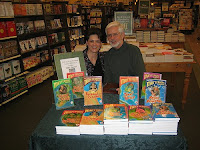
Monday, December 22, 2008

WILD CARD! Before the Season Ends by Linore Rose Burkard

It is time to play a Wild Card! Every now and then, a book that I have chosen to read is going to pop up as a FIRST Wild Card Tour. Get dealt into the game! (Just click the button!) Wild Card Tours feature an author and his/her book's FIRST chapter!

You never know when I might play a wild card on you!


Today's Wild Card author is:


and the book:


Before the Season Ends

Harvest House Publishers (December 1, 2008)


ABOUT THE AUTHOR:


Linore Rose Burkard lives with her husband, five children, and ninety-year-old grandmother in southeastern Ohio. She homeschooled her children for ten years. Raised in New York, she graduated magna cum laude from the City University of New York (Queens College) with a Bachelor of Arts in English literature. Ms. Burkard wrote Before the Season Ends because she could not find a book like it anywhere. "There are Christian books that approach this genre," she says, "but they fall short of being a genuine Regency. I finally gave up looking and wrote the book myself." She has begun four other works of fiction in the category.

Visit the author's website.

Product Details:

List Price: $ 12.99
Paperback: 348 pages
Publisher: Harvest House Publishers (December 1, 2008)
Language: English
ISBN-10: 0736925511
ISBN-13: 978-0736925518

AND NOW...THE FIRST CHAPTER:


Chesterton, Hertfordshire

England

1813

Something would have to be done about Ariana.

All winter Miss Ariana Forsythe, aged nineteen, had been going about the house sighing.

“Mr. Hathaway is my lot in life!”

She spoke as though the prospect of that life was a great burden to bear, but one which she had properly reconciled herself to. When her declarations met with exasperation or reproach from her family—for no one else was convinced Mr. Hathaway, the rector, was her lot—she usually responded in a perplexed manner. Hadn't they understood for an age that her calling was to wed a man of the cloth? Was there another man of God, other than their rector, available to her? No. It only stood to reason, therefore, that Mr. Hathaway was her lot in life. Their cold reception to the thought of the marriage was unfathomable.

When she was seventeen, (a perfectly respectable marrying age) she had romantic hopes about a young and brilliant assistant to the rector, one Mr. Stresham. It was shortly after meeting him, in fact, that she had formed the opinion the Almighty was calling her to marry a man of God. Mr. Stresham even had the approval of her parents. But the man took a situation in another parish without asking Ariana to accompany him as his wife. She was disappointed, but not one to give up easily, continued to speak of “the calling,” waiting in hope for another Mr. Stresham of sorts. But no man came. And now she had reached the conclusion that Mr. Hathaway--Mr. Hathaway, the rector, (approaching the age of sixty!) would have to do.

Her parents, Charles and Julia Forsythe, were sitting in their comfortably furnished morning room, Julia with a cup of tea before her, and Charles with his newspaper. A steady warmth was emanating from the hearth.

“What shall we do about Ariana?” Mrs. Forsythe, being an observant mama, had been growing in her conviction that the situation called for some action.

“What do you suggest, my dear?” Her husband reluctantly folded his paper; he knew his wife wanted a discussion of the matter and that he would get precious little reading done until she had got it.

She held up a folded piece of foolscap: the annual letter from Agatha Bentley, Charles’s sister, asking for Alberta, the eldest Forsythe daughter, for the season in London. It had arrived the day before.

Aunt Bentley was a childless wealthy widow and a hopeless socialite. For the past three years she had written annually to tell her brother and his wife why they ought to let her sponsor their eldest daughter for a London season. She owned a house in Mayfair (could anything be more respectable than that?) and knew a great deal of the big-wigs in society. She had, in fact, that most important of commodities which the Forsythes completely lacked: connexions. And as Charles’s family were her only living relatives, she was prepared--even anxious--to serve as chaperon for her niece.

Much to the lady's frustration, Julia and Charles had annually extinguished her hopes, replying to her letters graciously but with the inevitable, “We cannot countenance a separation from our child at this time,” and so on. Charles was unflinching on this point, never doubting his girls would reap a greater benefit by remaining beneath his own roof. They knew full well, moreover, that Aunt Agatha could not hope, with all her money and connexions to find as suitable a husband for their offspring as was possible right in Chesterton.

Why not? For the profound reason that Aunt Bentley had no religion whatsoever.

And yet, due to the distressing state of affairs with Ariana, Julia wished to consider her latest offer. With the letter waving in her hand she said, “I think we ought to oblige your sister this year. She must be lonely, poor thing, and besides removing Ariana from the parish, a visit to the city could prove beneficial for her education.”

Ariana’s father silently considered the matter. His eldest daughter Alberta was as good as wed, having recently accepted an offer of marriage--to no one’s surprise--from John Norledge. Ariana, his second eldest, had been irksome in regard to the rector, but to pack her off to London? Surely the situation was not so dire as to warrant such a move.

“I think there is nothing else for it,” Mrs. Forsythe said emphatically. “Ariana is determined about Mr. Hathaway and, even though we can forbid her to speak to the man, she will pine and sigh and like as not drive me to distraction!”

Taking a pipe out of his waistcoat pocket (though he never smoked), Mr. Forsythe absently rubbed the polished wood in his fingers.

“I recall other fanciful notions of our daughter’s,” he said finally, “and they slipped away in time. Recall, if you will, when she was above certain her destiny was to be a missionary--to America. That desire faded. She fancies this, she fancies that; soon she will fancy another thing entirely, and we shan’t hear another word about the ‘wonderful rector’ again.”

Mrs. Forsythe’s countenance, still attractive in her forties, became fretful.

“I grant that she has had strong…affections before. But this time, my dear, it is a complicated affection for in this case it is the heart of the ah, affected, which we must consider. It has ideas of its own.”

“Of its own?”

Mrs. Forsythe looked about the room to be certain no one else had entered. The servants were so practiced at coming and going quietly, their presence might not be marked. But no, there was only the two of them. She lowered her voice anyway.

“The rector! I do not think he intends to lose her! What could delight him more than a young, healthy wife who might fill his table with offspring?”

Mr. Forsythe shook his head.”Our rector is not the man to think only of himself; he must agree with us on the obvious unsuitability of the match.”

The rector was Thaddeus Admonicus Hathaway, of the Church in the Village Square. Mr. Hathaway was a good man. His sermons were grounded in sound religion, which meant they were based on orthodox Christian teaching. He was clever, and a popular dinner guest of the gentry, including the Forsythes. If these had not been true of him, Mr. Forsythe might have been as concerned as his wife. Knowing Mr. Hathaway, however, Charles Forsythe did not think a drastic action such as sending his daughter to the bustling metropolis of London, was necessary.

Mrs. Forsythe chose not to argue with her spouse. She would simply commit the matter to prayer. If the Almighty decided that Ariana must be removed to Agatha’s house, then He would make it clear to her husband. In her years of marriage she had discovered that God was the Great Communicator, and she had no right to try and usurp that power. Her part was to pray, sincerely and earnestly.

Mr. Forsythe gave his judgment: “I fear that rather than exerting a godly influence upon her aunt, Ariana would be drawn astray by the ungodliness of London society.”

“Do you doubt her so much, Charles? This infatuation with Mr. Hathaway merely results from her youth, her admiration for his superior learning, and especially,” she said, leaning forward and giving him a meaningful look, “for lack of a young man who has your approval! Have you not frowned upon every male who has approached her in the past? Why, Mr. Hathaway is the first whom you have failed to frighten off and only because he is our rector! 'Tis little wonder a young girl takes a fanciful notion into her head!”

When he made no answer, she added, while adjusting the frilly morning cap on her head, “Mr. Hathaway causes me concern!”

Mr. Forsythe’s countenance was sober. “’Tis my sister who warrants the concern. She will wish to make a match for our daughter--and she will not be content with just any mister I assure you. In addition to which, a girl as pretty as our daughter will undoubtedly attract attention of the wrong sort.”

Julia was flustered for a second, but countered, “Agatha is no threat to our child. We shall say we are sending Ariana to see the sights, take in the museums and so forth. Surely there is no harm in that. A dinner party here or there should not be of concern. And Ariana is too intelligent to allow herself to be foisted upon an unsuitable man for a fortune or title.”

Too intelligent? He thought of the aging minister that no one had had to “foist” her upon. Aloud he merely said, “I shall speak with her tonight. She shall be brought to reason, depend upon it. There will be no need to pack her off to London.”

Sunday, December 21, 2008

statistic poll....to the rightside of the blog....please place your vote! and maybe comment too

I'm currently running the poll to the righthand side of this blog to see what the majority of people who were kicked from FIRST fell under....a statistic if you will.

I'm a very curious person by nature so this opportunity is too good to pass up.

this is the post where you can comment and say which category you fell under if you like.
oh and I apologize to anybody I got to join if they got kicked....I did too so I don't feel as bad as I would if I had somehow managed to 'qualify'.

TEENFIRST! The Sword and the Flute by Mike Hamel


It's the 21st, time for the Teen FIRST blog tour! This is the very last Teen FIRST tour as Teen FIRST has merged with FIRST Wild Card Tours. If you wish to learn more about FIRST Wild Card, please go HERE.


and his book:


Amg Publishers (January 22, 2007)


ABOUT THE AUTHOR:


Mike Hamel is a seasoned storyteller who has honed his skill over theyears by telling tall tales to his four children. He is the author of several non-fiction books and numerous magazine articles.

Mike and his wife, Susan, live in Colorado Springs, CO. Their four children are now grown and their two grand children will soon be old enough for stories of their own.

From His Blog's About Me:

I am a professional writer with sixteen books to my credit, including a trilogy of titles dealing with faith and business: The Entrepreneur’s Creed (Broadman, 2001), Executive Influence (NavPress, 2003), and Giving Back (NavPress, 2003). I also edited Serving Two Masters: Reflections on God and Profit, by Bill Pollard (Collins, 2006).


My most enjoyable project to date has been an eight-volume juvenile fiction series called Matterhorn the Brave. It’s based on variegated yarns I used to spin for my four children. They are now grown and my two grandchildren will soon be old enough for stories of their own.

I live in Colorado Springs, Colorado with my bride of 34 years, Susan.

As you read this blog, remember that I’m a professional. Don’t try this level of writing at home. You might suffer a dangling participle or accidentally split an infinitive and the grammarians will be all over you like shoe salesmen on a centipede.

BTW – I have been diagnosed with Diffuse Large B-Cell Lymphoma, an aggressive but treatable form of cancer.


Mike's Blog, Cells Behaving Badly, is an online diary about Wrestling with Lymphoma Cancer.

To order a signed edition of any of the 6 Matterhorn the Brave books, please visit the Matterhorn the Brave Website!

Product Details

List Price: 9.99
Reading level: Ages 9-12
Paperback: 181 pages
Publisher: Amg Publishers (January 22, 2007)
Language: English
ISBN-10: 0899578330
ISBN-13: 978-0899578330


AND NOW...THE FIRST CHAPTER:

Emerald Isle


Aaron the Baron hit the ground like a paratrooper, bending his knees, keeping his balance.

Matterhorn landed like a 210-pound sack of dirt.

His stomach arrived a few seconds later.

He straightened his six-foot-four frame into a sitting position. In the noonday sun he saw they were near the edge of a sloping meadow. The velvet grass was dotted with purple and yellow flowers. Azaleas bloomed in rainbows around the green expanse. The black-faced sheep mowing the far end of the field paid no attention to the new arrivals.

“Are you okay?” the Baron asked. He looked as if he’d just stepped out of a Marines’ recruiting poster. “We’ll have to work on your landing technique.”

“How about warning me when we’re going somewhere,” Matterhorn grumbled.

The Baron helped him up and checked his pack to make sure nothing was damaged. He scanned the landscape in all directions from beneath the brim of his red corduroy baseball cap. “It makes no difference which way we go,” he said at last. “The horses will find us.”

“What horses?”

“The horses that will take us to the one we came to see,” the Baron answered.

“Are you always this vague or do you just not know what you’re doing?”

“I don’t know much, but I suspect this is somebody’s field. We don’t want to be caught trespassing. Let’s go.”

They left the meadow, walking single file through the tall azaleas up a narrow valley. Thorny bushes with loud yellow blossoms crowded the trail next to a clear brook. Pushing one of the prickly plants away, Matterhorn asked, “Do you know what these are?”

“Gorse, of course,” the Baron said without turning.

“Never heard of it.”

“Then I guess you haven’t been to Ireland before.”

“Ireland,” Matterhorn repeated. “My great-grandfather came from Ireland.”

“Your great-grandfather won’t be born for centuries yet.”

Matterhorn stepped over a tangle of exposed roots and said, “What do you mean?”

“I mean we’re in medieval Ireland, not modern Ireland.”

“How can that be!” Matterhorn cried, stopping in his tracks. “How can I be alive before my great-grandfather?”

The Baron shrugged. “That’s one of the paradoxes of time travel. No one’s been able to figure them all out. You’re welcome to try, but while you’re at it, keep a lookout for the horses.”

Matterhorn soon gave up on paradoxes and became absorbed in the paradise around him. The colors were so alive they hurt his eyes. He wished for a pair of sunglasses. Above the garish gorse he saw broom bushes and pine trees growing to the ridge where spectacular golden oaks crowned the slopes. Birdsongs whistled from their massive branches into the warm air. Small animals whispered in the underbrush while larger game watched the strangers from a distance.

The country flattened out and, at times, they glimpsed stone houses over the tops of hedgerows. They steered clear of these and any other signs of civilization. In a few hours, they reached the spring that fed the brook they had been following. They stopped to rest and wash up.

That’s where the horses found them.

There were five strikingly handsome animals. The leader of the pack was from ancient and noble stock. He stood a proud seventeen hands high—five-foot-eight-inches—at the shoulders. He had a classic Roman face with a white star on his wide forehead that matched the white socks on his forelegs. His straight back, sturdy body, and broad hindquarters suggested both power and speed. A rich coppery mane and tail complemented his sleek, chestnut coat.

The Baron held out an apple to the magnificent animal, but the horse showed no interest in the fruit or the man. Neither did the second horse. The third, a dappled stallion, took the apple and let the Baron pet his nose.

“These horses are free,” the Baron said as he stroked the stallion’s neck. “They choose their riders, which is as it should be. Grab an apple and find your mount.”

While Matterhorn searched for some fruit, the leader sauntered over and tried to stick his big nose into Matterhorn’s pack. When Matterhorn produced an apple, the horse pushed it aside and kept sniffing.

Did he want carrots, Matterhorn wondered? How about the peanut butter sandwich? Not until he produced a pocket-size Snickers bar did the horse whinny and nod his approval.

The Baron chuckled as Matterhorn peeled the bar and watched it disappear in a loud slurp. “That one’s got a sweet tooth,” he said.

The three other horses wandered off while the Baron and Matterhorn figured out how to secure their packs to the two that remained. “I take it we’re riding without saddles or bridles,” Matterhorn said. This made him nervous, as he had been on horseback only once before.

“Bridles aren’t necessary,” Aaron the Baron explained. “Just hold on to his mane and stay centered.” He boosted Matterhorn onto his mount. “The horses have been sent for us. They’ll make sure we get where we need to go.”

As they set off, Matterhorn grabbed two handfuls of long mane from the crest of the horse’s neck. He relaxed when he realized the horse was carrying him as carefully as if a carton of eggs was balanced on his back. Sitting upright, he patted the animal’s neck. “Hey, Baron; check out this birthmark.” He rubbed a dark knot of tufted hair on the chestnut’s right shoulder. “It looks like a piece of broccoli. I’m going to call him Broc.”

“Call him what you want,” the Baron said, “but you can’t name him. The Maker gives the animals their names. A name is like a label; it tells you what’s on the inside. Only the Maker knows that.”

Much later, and miles farther into the gentle hills, they made camp in a lea near a tangle of beech trees. “You get some wood,” Aaron the Baron said, “while I make a fire pit.” He loosened a piece of hollow tubing from the side of his pack and gave it a sharp twirl. Two flanges unrolled outward and clicked into place to form the blade of a short spade. Next, he pulled off the top section and stuck it back on at a ninety-degree angle to make a handle.

Matterhorn whistled. “Cool!”

“Cool is what we’ll be if you don’t get going.”

Matterhorn hurried into the forest. He was thankful to be alone for the first time since becoming an adult, something that happened in an instant earlier that day. Seizing a branch, he did a dozen chin-ups; then dropped and did fifty push-ups and a hundred sit-ups.

Afterward he rested against a tree trunk and encircled his right thigh with both hands. His fingertips didn’t touch. Reaching farther down, he squeezed a rock-hard calf muscle.

All this bulk was new to him, yet it didn’t feel strange. This was his body, grown up and fully developed. Flesh of his flesh; bone of his bone. Even hair of his hair, he thought, as he combed his fingers through the thick red ponytail.

He took the Sword hilt from his hip. The diamond blade extended and caught the late afternoon sun in a dazzling flash. This mysterious weapon was the reason he was looking for firewood in an Irish forest instead of sitting in the library at David R. Sanford Middle School.

Monday, December 15, 2008

NONFIRST! The Jesus Who Never Lived by H. Wayne House


It's the 15th, time for the Non~FIRST blog tour!(Non~FIRST will be merging with FIRST Wild Card Tours on January 1, 2009...if interested in joining, click HERE!)


The feature author is:


and his book:


Harvest House Publishers (August 1, 2008)


ABOUT THE AUTHOR:

H. Wayne House (ThD, JD) is a Distinguished Research Professor of Biblical and Theological Studies at Faith Evangelical Seminary (Tacoma, WA). and Adjunct Professor of Law, Trinity Law School of Trinity International University. He is the New Testament editor of the Nelson Study Bible and Nelson Illustrated Bible Commentary, and the General Editor of Nelson Exegetical Commentary (42 vols), Israel: the Land and the People, and Charts of Bible Prophecy, among the 30 books that he has authored, co-authored, or edited.

Dr. House has been a professor of biblical studies, theology or law for more than thirty years at such places as Western Seminary in Portland, Oregon; Dallas Theological Seminary, Dallas, Texas; Simon Greenleaf School of Law, Anaheim, California; Michigan Theological Seminary, Plymouth, Michigan, and Trinity Graduate School and Trinity Law School, Santa Ana, California, California campus of Trinity International University, Deerfield, IL. Through this internet office we hope to help those who are interested in several topics within apologetics, including Christianity and culture, law, science, cultism, philosophy, theology, and biblical studies. Dr. House also leads Bible study tours to Israel, Jordan, Egypt, Rome, Greece, and Turkey.

Visit his
AND NOW...THE FIRST CHAPTER:


What’s It All About?

In the Broadway play and later film Jesus Christ Superstar, Mary Magdalene asks, “What’s it all about?” as she tries to figure out who this man called Jesus really is. Certainly there are aspects about the song she sings, and suggestions made in the play, contrary to what we know from the canonical Gospels about the relationship of Mary and Jesus. But she does pose some important issues. She is puzzled about how to relate to Jesus as she has with other men, and this association with Him has made major changes in her emotions, actions, and thoughts. The reason she struggles is her perception that “he’s just a man.” If Jesus is just a man, then why does He captivate her so and cause her to evaluate herself to the depths of her soul? Such questions about Jesus and the impact of His ministry, death, and resurrection have been asked for two millennia.

Every year around Christmas and Easter the news media show an interest in Jesus. Rarely do they speak to people who believe in the Jesus who has been worshipped by the church since its earliest period until now. Rather, the fascination is with a Jesus re-imaged by people who have little interest in the historical record preserved in the New Testament.

This interest in Jesus, unconnected to the earliest tradition and history we have of Him, is not a new phenomenon. Toward the end of the first century of the Christian era, perceptions of Jesus began to arise that were different from what He said about Himself as recorded in Matthew, Mark, Luke, and John and proclaimed by the apostle Paul. Jesus has become the favorite of ancient heretics, founders of various world religions, modern novelists, Hollywood and documentary filmmakers, New Age teachers, adherents of popular religion, and over-the-edge liberal scholars. He is by far the most popular, and possibly most distorted, figure of history.

When Christianity was less than a hundred years old, we find two groups at different ends of the spectrum in their views of Jesus. One Jewish group, known as the Ebionites (late first century), accepted Jesus as the Messiah from God, acknowledged His humanity, but rejected His deity. On the other side were the Gnostics (early second century), who accepted Jesus as a divine figure but denied His true humanity. This rise of Gnosticism coincides with the demise, though not extinction, of Jewish Christianity, toward the end of the first century and beginning of the second century. Such views of the Christ were rejected by the apostolic church, and the view supported by the New Testament was finally put in creedal form, in a number of creeds, by the end of the fifth century.

Since those early centuries various religions have been enamored of Jesus. Eastern religions see Jesus as one of the avatars, or manifestations of God, and Islam considers Him a prophet (see chapter 8 for both topics). In the former, Jesus is an Eastern mystic, sometimes even viewed as having been trained in India, and in the latter as one who promoted Islam.

Muhammad was a pagan who had contact with Jews and Christians from Arabia and finally became monotheistic, in the first quarter of the seventh century after Christ embracing one of the over 300 Arabian deities: Allah, the moon god. In his limited investigation into Christianity, he came to believe, as is recorded in the Qur’an, that Jesus was born of a virgin, was sinless throughout His life, performed miracles, ascended to God, and will come again in judgment. He acknowledged all of these things about Jesus, considering none of these to be true of himself. Nonetheless, Jesus is never considered more than one of the prophets of Islam; He is not God in the flesh. Inside the Dome of the Rock on the Temple Mount, the walls are inscribed with statements that God does not have a Son, specifically addressed against the Christian doctrines of the divinity of Jesus and the Trinity. As we shall see in a later chapter, Muhammad and his followers misunderstood the Christian doctrine of God.

In the eighteenth century, with the Enlightenment came skepticism about Christianity and absolute truth in religion. Biblical scholars and philosophers began to scrutinize claims that Jesus was more than human, and for over 200 years a search, or “quest,” for the historical Jesus has been pursued. We have now entered the third quest. While many within the second quest remain skeptical, there is growing support among some in the third quest for the credibility of the Jesus portrayed in the New Testament. In contrast to those who have little regard for biblical and extrabiblical history, scholars of both liberal and conservative persuasion now agree that within a couple of years following the death of Christ, the church preached a consistent message about His death and resurrection. Christ’s followers considered Him both God and man, Lord and Savior. And those who became believers in the latter part of the first century and early second century continued to accept Jesus as portrayed in the Gospels. The church’s belief in Jesus’ deity and humanity did not begin with the Council of Nicaea in AD 325, as encouraged by the Emperor Constantine; that belief was present from the church’s very beginning.

The Importance of Jesus

Though contemporary novelists and media sensationalists never tire of trying to find some new angle on Jesus to attract an audience, most serious historians and biblical scholars are impressed with the evidence in the Gospels for the Jesus who lived, taught, performed miracles, died, was buried, and rose again from the dead. An early twentieth-century composition by a devoted believer captures the wonder of Jesus:

He was born in an obscure village, the child of a peasant woman. He grew up in another village, where he worked in a carpenter shop until He was thirty. Then for three years He was an itinerant preacher. He never wrote a book. He never held an office. He never had a family or owned a home. He didn’t go to college. He never visited a big city. He never traveled two hundred miles from the place where He was born. He did none of the things that usually accompany greatness. He had no credentials but Himself.

He was only thirty-three when the tide of public opinion turned against Him. His friends ran away. One of them denied Him. He was turned over to His enemies and went through the mockery of a trial. He was nailed to a cross between two thieves.

While He was dying, His executioners gambled for His garments, the only property He had on earth. When He was dead, He was laid in a borrowed grave through the pity of a friend.

Nineteen centuries have come and gone, and today He is the central figure of the human race. All the armies that ever marched, all the navies that ever sailed, all the parliaments that ever sat, all the kings that ever reigned, put together, have not affected the life of man on this earth as much as that one solitary life.

But believers in the divine Jesus aren’t the only ones who admire Him. Marcus Borg, a member of the Jesus Seminar and distinguished professor emeritus of philosophy and religion at Oregon State University, speaks as a skeptical historian about the significance and uniqueness of Jesus:

The historical Jesus is of interest for many reasons. Not least of these is his towering cultural significance in the nearly two thousand years since his death. No other figure in the history of the West has ever been accorded such extraordinary status. Within a few decades of his death, stories were told about his miraculous birth. By the end of the first century, he was extolled with the most exalted titles known within the religious tradition out of which he came: Son of God, one with the Father, the Word become flesh, the bread of life, the light of the world, the one who would come again as cosmic judge and Lord. Within a few centuries he had become Lord of the empire that had crucified him.

For over a thousand years, thereafter, he dominated the culture of the West: its religion and devotion, its art, music, and architecture, its intellectual thought and ethical norms, even its politics. Our calendar affirms his life as a dividing point in world history. On historical grounds alone, with no convictions of faith shaping the verdict, Jesus is the most important figure in Western (and perhaps human) history.

These words of exuberant praise from a historian who does not accept Jesus as God in the flesh further indicates the amazing manner in which a human being was able to draw devoted followers by the magnetism of His life and teachings. Jaroslav Pelikan, noted historian of Yale University, has said of Jesus,

Regardless of what anyone may personally think or believe about him, Jesus of Nazareth has been the dominant figure in the history of Western culture for almost twenty centuries. If it were possible, with some sort of supermagnet, to pull up of that history every scrap of metal bearing at least a trace of his name, how much would be left? It is from his birth that most of the human race dates its calendars, it is by his name that millions curse and in his name that millions pray.

The world would be a considerably different place, with far less progress, peace, and hope than we possess today, had He not lived.

Liking Jesus Without Knowing Him

Just about everyone likes Jesus. How could they not, in view of the outstanding reception He has received throughout history, right? Not really. Much of the fascination with Jesus comes from those who really don’t know much about Him. Were He to confront them with His teachings and call them to a life of obedience to His will, they might be part of the recalcitrant crowd crying out, “Crucify, crucify him!” (Luke 23:21).

Today a large number of people say they are attracted to Jesus but dislike His church. They see within the church people who are inconsistent in their practice of Christian ethics and fail to follow what they understand to be the teachings of Jesus. The church is viewed as judgmental, whereas Jesus said not to judge. The church speaks against sins such as homosexual relationships, whereas Jesus loved all people regardless of their sin, such as the woman caught in adultery. The church has interest in political matters, but Jesus did not involve Himself in politics and worked only to ease people’s burdens. (Whether these notions are true or not will be briefly discussed in chapter 12.)

This attempt to understand Jesus is often done without any reference to what we really know about Him. We simply guess who He is and how He acted—most often, how we think He ought to be and act to be acceptable to the twenty-first-century mind. Apart from the appeal to divine revelation, this is the manner in which He has been viewed over the centuries, including the century in which He lived on earth.

“Who Do People Say That I Am?”

As Jesus traveled with His disciples to Caesarea Philippi, He posed an important question: “Who do people say that I am?” (Mark 8:27). The response to this question divides light and darkness, death and life. The disciples said that some believed Him to be an important prophet, but the apostles—specifically Peter—proclaimed His deity, a truth revealed to him by the Father. It is this authentic Christ, based on credible biblical and extrabiblical sources, whom we must encounter.

Each of us is confronted with important questions and priorities in this life. Some are of minor importance, but others have lasting, even eternal significance. The most important issue we must squarely confront is our relationship with God and, consequently, our final destiny. This is true not only for people today, it was also important in the first century when Jesus the Messiah came to earth. This is evident in the words of Christ that if people did not believe that He was “from above” (heaven), they would die in their sins (John 8:21-24).

Jesus the Prophet of God

In general, people liked Jesus Christ, as is true even today. The Scripture says that “the common people heard him gladly” (Mark 12:37). Saying this, however, does not mean they always understood His message (Matthew 13:10-17) or understood who He was:

When Jesus came into the district of Caesarea Philippi, he asked his disciples, “Who do people say that the Son of Man is?” And they said, “Some say John the Baptist, others say Elijah, and others Jeremiah or one of the prophets.” He said to them, “But who do you say that I am?” Simon Peter replied, “You are the Christ, the Son of the living God.” And Jesus answered him, “Blessed are you, Simon Bar-Jonah! For flesh and blood has not revealed this to you, but my Father who is in heaven” (Matthew 16:13-17).

The people during that time enjoyed what so many of us greatly desire—personal communication with the Son of God—yet they failed to understand Him. Many of them were miraculously fed and healed by Him. They heard His word with their own ears and saw Him with their own eyes. No doubt many also touched Him with their hands. To have the opportunity these people enjoyed seems too wonderful to imagine.

But when Jesus asked the disciples who the people thought He was, they cited many important figures of Jewish history, from John the Baptist (apparently thought to have been raised from the dead) to Elijah, who was to be forerunner of the Messiah (Malachi 4:5), to Jeremiah, who confronted the Northern Kingdom of Israel for its sins, or to some other prophet, as seen below:

John the Baptist. John the Baptist would have been a natural choice for the identification of Jesus, particularly by those who had not encountered John personally and maybe hadn’t heard the news of his death. John spent his ministry in the desert, baptizing in Bethabara beyond the Jordan, whereas the people in view here are in Galilee or maybe the Golan. Otherwise it seems unlikely they would have made such a connection, unless they believed that Jesus was the resurrected John, which is what Herod Antipas thought: “At that time Herod the tetrarch heard the report about Jesus and said to his servants, ‘This is John the Baptist; he is risen from the dead, and therefore these powers are at work in him’” (Matthew 14:1-2). In the words of D.A. Carson:

His conclusion, that this was John the Baptist, risen from the dead (v. 2), is of great interest. It reflects an eclectic set of beliefs, one of them the Pharisaic understanding of resurrection. During his ministry John had performed no miracles (John 10:41); therefore Herod ascribes the miracles in Jesus’ ministry, not to John, but to John “risen from the dead.” Herod’s guilty conscience apparently combined with a superstitious view of miracles to generate this theory.

Though Herod’s superstition may be the cause for his comments, such a view is not unheard of in literature that precedes the New Testament. Albright and Mann say, “)The reappearance of dead heroes was a well-known theme in contemporary Jewish thought…[Second Maccabees 15:12-16] speaks of Jeremiah and Onias appearing to Judas Maccabaeus, and [2 Esdras 2:18-19] refers to the coming of Isaiah and Jeremiah.”

Elijah. Identifying Jesus as Elijah may appear surprising, except that Jesus’ ability to do miracles and the expectation of Messiah’s coming might have caused the people to believe He was preparing the way for the Messiah in agreement with Malachi’s prophecy:

Behold, I will send you Elijah the prophet

Before the coming of the great and dreadful day of the Lord.

—Malachi 4:5 nkjv

The disciples had similar expectations about Elijah, whom Jesus connected to John the Baptist as His forerunner (Matthew 17:10-12).

There are indeed many similarities between Elijah and Jesus. Elijah exercised control over the forces of nature, telling Ahab his land would have no precipitation for several years (1 Kings 17:1-2).

In the midst of this judgment against Israel, God sent Elijah to the Phoenician city of Zarephath of Sidon, to a widow and her son who were facing starvation. To test her faith, Elijah asked her to make him some bread from the handful of flour and the little oil she had left. After she complied with Elijah’s request, the jar of flour and the jug of oil did not become empty until the famine ended (17:14-16).

Later, the woman’s son died, and the prophet of God brought him back to life (17:17-24). These spectacular miracles performed for a non-Israelite mother and her son reveal not only the power of God but also the love of God for all people.

Those people who saw the ministry and attitude of Jesus no doubt considered Him to be like Elijah because He also controlled the forces of nature. On the mountain near the shore of the Lake of Galilee He multiplied bread and fish (Matthew 15:29-38), and He raised a widow’s son who had died (Luke 7:11-17).

Jeremiah. The last prophet to whom Jesus is likened is Jeremiah. What in the life and character of Jeremiah served as a basis for comparison with Jesus?

Donald Hagner says there are a “number of obvious parallels between Jesus and Jeremiah, such as the preaching of judgment against the people and the temple, and especially in suffering and martyrdom.” The message of Jeremiah was God’s judgment against an unfaithful people (Jeremiah 1:16). Jesus presented a similar kind of message when He pronounced woe against Chorazin and Bethsaida (Matthew 11:20-24).

Jesus offered healing and solace to the sick and downtrodden, but to the proud and rebellious, the words of this “prophet from Nazareth” (Matthew 21:11) were sharp and powerful. Another point of similarity may be Jesus’ cleansing of the temple and His indictment of those there (Matthew 21:10-13), and Jeremiah’s rebuke in his famous temple sermon (Jeremiah 7:1-15). Both texts even accuse the unfaithful of making God’s house a “den of robbers.”

One of the prophets. Even if there was disagreement among the people about Jesus’ identity, one thing is certain: They knew He was special, for He was viewed at minimum as a prophet. Just listening and watching Jesus revealed that He was powerful and insightful. This testimony—that the people identified Jesus with the prophets—demonstrates they held diverse eschatological expectations but there was no mass acknowledgment of Him as Messiah. The occasional reference to Jesus as the Son of David, found several times before Matthew 16, does not contradict the lack of recognition of Him as Messiah.

Fortunately, we also see among some non-Jews a different response. The Samaritan woman at the well first viewed Jesus as a Jewish man, then a prophet, then the Messiah, and finally the Savior (John 4:4-42).

Whether they believed He was God’s Messiah or one of the great prophets of Israel, all thought He was a person of great importance with divine authority and a powerful presence and message.

Messiah, Son of God

After the disciples responded to Jesus’ question about how the people viewed Him, He asked, “But who do you say that I am?” (Mark 8:29). Would the disciples have a more accurate perception of their master than the general populace? You would think that their intimate relationship with Jesus would have made His identity clear in their minds. Yet this is not what we find. Though Peter correctly says that Jesus is the Messiah (christos, Greek translation of Hebrew mashiach, “anointed one”), the Son of the living God (16:16), Jesus says that the knowledge that gave rise to this confession came from heaven rather than from human insight (Matthew 16:13-17).

Is this confession true? Or is Jesus no more than a man, as the character of Mary sings in Jesus Christ Superstar? The Jesus who came to earth 2000 years ago has spawned a myriad of ideas about who He was and is. No more important subject than this confronts us today. Even among those who do not embrace the bodily resurrection of the crucified Messiah and His claims to deity, there is considerable praise. As Borg said of Him, “On historical grounds alone, with no convictions of faith shaping the verdict, Jesus is the most important figure in Western (and perhaps human) history.”

But is He only this—or is He, as Peter confessed, the Messiah, the Son of the living God? Our crucial quest in this book is to discover the true Jesus among the various visions of Him that have been constructed since His death and resurrection.

Tuesday, December 9, 2008

WILD CARD! The Christmas Edition by Robin Shope

It is time to play a Wild Card! Every now and then, a book that I have chosen to read is going to pop up as a FIRST Wild Card Tour. Get dealt into the game! (Just click the button!) Wild Card Tours feature an author and his/her book's FIRST chapter!

You never know when I might play a wild card on you!


Today's Wild Card author is:


and the book:


The Christmas Edition – first book in The Turtle Creek Edition series

The Wild Rose Press (November 21, 2008)


ABOUT THE AUTHOR:


In Robin's words:

I am the Special Education Coordinator for Denton County Juvenile Justice Alternative Program. I work with at risk teens from fifth grade through high school. My husband and I have been married for thirty-one years and we have two grown children. The first two years of marriage, Rick and I traveled overseas as missionaries. Afterwards we served as pastors of a church in Illinois. Presently we live near Dallas, Texas. He is in business and I work for the school system. (My husband still makes yearly mission trips to India.)

To date, my literary works include approximately two hundred articles in magazines such as: Guideposts, Live, Lookout, Mennonite, Christian Reader, Decision, Breakthrough and Christianity Today. Other short stories appear in the books: A Match Made in Heaven, Stories from the Heart, The Evolving Woman, and the New York Times bestseller, In The Arms of Angels by Joan Wester-Anderson. Ann Spangler also used one of my stories in her book, Help! I Can’t Stop Laughing. Another two-dozen stories have been published in the Chicken Soup books. One story, Mom’s Last Laugh, was re-enacted for a PAX-TV program: It’s a Miracle. I co-authored a thriller, The Chase, for Revell. My second book, The Replacement, was released in June 2006. The Candidate was released July, 2007. I continue to publish short stories in magazines. Wildcard, a mystery, will be a spring 2009 release. The Christmas Edition releases Nov. 20. The Valentine Edition releases in January 2009.


Visit the author's website.

Product Details:

List Price: $ 11.99
Paperback: 236 pages
Publisher: The Wild Rose Press (November 21, 2008)
Language: English
ISBN-10: 1601543301
ISBN-13: 978-1601543301

AND NOW...THE FIRST CHAPTER:


December 1

The usual winter blizzard blew into southern

Wisconsin.


Lucy Collins carefully maneuvered her car

through the snow that grew deeper with every gust

of wind. She parked directly in front of her family

owned business, The Turtle Creek Newspaper, just

as her brother, Mike, was making his second pass at

clearing away the snow from the drive with the

snow blower.


“Hey, Mike! Help me carry these inside, will

you?” Lucy called to him as she got out of her heated

car. A sharp wind sucked up her words and nearly

knocked her off balance.


Mike turned off the blower and cupped his hand

around his ear. “What did you say?” His breath

circled around his face in the frigid air.


“Help!” Lucy hollered. She popped the trunk and

pivoted her body in an exaggerated fashion-the way

models do when showcasing prizes on a game show.

She stepped to the other side and waved her hands,

palms up, along the food trays and her mother’s

crystal punch bowl set. Then she flashed her

younger brother her biggest smile.


Mike galloped up to the car just as another gust

of wind, hammered snow at them. “It’s freezing out

here! Even my nose hairs are frozen solid. You go on

in. I’ll get these as soon as I’m finished shoveling the

walk.”


“Thanks.” Lucy gave him a kiss on the cheek. To

keep her balance, she gingerly walked across the

crunchy ice crystals and into the warm building.

Once inside, she tugged off one boot and then the

other, dropping them under her desk. She hung her

coat and scarf on the back of her swivel chair as she

looked around at the decorations of wreaths and

holly. A sprig of mistletoe hung over the empty desk

at the back. That would surely go to waste. Music

played loudly from her dad’s old stereo inside his

office.


Christmas used to be her favorite holiday, but

after a disastrous end to her engagement, a couple of

years ago, this particular holiday now only served as

a dark reminder of broken promises. With prayer

and a loving family, Lucy was ready to start her life

again, which meant buying her own place right after

the first of the year. Working and living with the

same people was often stifling, especially when

they’re her parents.


Lucy’s mom was the cheerleader as well as the

gopher, making sure everyone had what they

needed, whereas Lucy’s father focused persistently

on getting the next edition out and on time.

Each year at Christmastime, however, Harold

Collins took off his publisher hat and donned

something completely different. The weeks wedged

between Thanksgiving and Christmas became about

assisting others. She loved it all and nothing could

ever take her away from this life.


The employees had finished packing up the last

of the boxes from the food drive which were now

stacked neatly, ready to be dropped off at area

shelters. Lucy wanted to acknowledge all the work

they’d done. “For a small cluster of people, we sure

accomplish a truckload of work, fast! These

donations will help many people down and out this

holiday season. Like all the other years we’ve

worked closely together and done a great job.”

Christmas was about unbridled joy but today, try as

she may, she still wasn’t feeling it. Maybe she could

fake it for everyone’s sake. Lucy lowered her head in

modesty and stated, “This is going to be a Christmas

of miracles.”


As if releasing faith into the air, everyone began

to punctuate her words with applause. Right on cue,

Harold Collins stepped out of his office wearing a hat

something like one of the elves might wear. He even

bobbed his head up and down to show off the cluster

of bells that dangled at the tip of the loopy crown.

Lucy couldn’t help but have her first laugh of the

day, along with the other employees.


“I know it’s still over a month until Christmas

but I thought you could use this now,” Harold said as

he produced a fan of festive red and green envelopes.


Squeals of delight resonated as they opened the

envelopes and saw the amount written on the checks

but none was as loud as Ulilla Langston. Lucy’s dad

had inherited her along with the paper when her

grandpa died. Ulilla was a beautiful, black woman

with hair swept close to her head in a French twist.

She carried weight around the place both literally

and figuratively.


“Harold and Margaret Collins,” she crowed, as

her hand fluttered to her chest. “No way can you

afford to give us this.”


“Nonsense!” Harold blustered, and politely

dismissed her words of protest with a wave. “It

should be three times this and you know it! You all

have worked effortlessly and clocked in many

overtime hours in order to get the newspaper out

each week. I am the one who is grateful. Merry

Christmas!”


The bell above the front door jingled as Mike

walked in balancing the punch bowl along with the

holiday trays. “Where do you want these, sis?”


“Let me help with that.” Lucy took the top two

trays. “Take the rest into the break room. I’ll follow

you in.”


Margaret touched the sleeve of Lucy’s cardigan.


“Have you finished our Christmas cards yet?”


“I started a month ago and finally finished them

last night. Not only did I hand write each one, but

the envelopes are addressed and stamped.”


“Which of the photographs did you decide on?”


“I thought I told you that all ready. Never mind,

there’s one in my desk I’ll show you.” Lucy set down

the trays. From the desk drawer, she took a single

envelope and handed it to her mother. “Here, I was

looking for something that would embody a perfect

form of truth when it comes to Christianity.”


Margaret stared at the card. A country church

was nestled into a hillside surrounded on all sides by

fresh snowfall. Above, the sky was brilliant blue.

Lucy looked over her mother’s shoulder. She

scrunched her face, second-guessing her

photographic choice. “Does it look okay?”


“It’s a whole lot more than okay. This is simply

breathtaking and looks professionally done. Lucy,

you should have put your logo somewhere on this

card so people would be aware that you are the one

who took this photograph of our church.” Margaret’s

eyes glistened.


“Not this time. I want people to focus on the

birth of our Savior and the hope He gives for our

lives. Mom, in the past year, I have become more

appreciative of the upbringing you and Dad gave

Mike and me and how you shared your faith which

has now become mine.” Lucy choked back her tears

and touched the silver cross she always wore at her

neckline.


“Those words are the best gift you could ever

give to me.” Margaret hugged her daughter. “I want

nothing more this season than to see you happy.”

Lucy hugged back tightly. “I’m working hard on

that.”


“Lucy!” Mike called from the break room. “I

thought you said you were following me in. I’m

making a mess of things trying to get the food set

up.”


“Ah, I better go rescue the food from Mike and

start the punch.” Lucy picked up the trays. “By the

way, it’s getting worse outside so could you suggest

to Dad that we better let everyone go home early.”


“I will, but right now, I want to lend you a

hand.”


Lucy and Mike uncovered the trays of fruit,

cheese, and crackers. Margaret took her home baked

pastries from the refrigerator and arranged them on

top of doilies set on antique dessert plates. Mike

dumped plastic forks from the box into a basket and

then tore open the plates while Lucy poured the

punch into the bowl and added scoops of sherbet. “I

think we’re ready.”


Once everyone had gathered in the break room,

Harold asked one and all to join hands. Together

they asked for the Lord’s blessing. Then they dug in;

plates were quickly filled with condiments, the

routine appetizers, rolled pieces of meat, decorated

sugar cookies, and cinnamon rolls. That was just for

starters. Margaret kept laying out more and more

food.


Lucy sat at the edge of her chair and sipped her

cup of punch. It was fun watching everyone enjoy

themselves. She closed her eyes and drank in their

laughter. This is what she needed, to be surrounded

by such love and acceptance.


The employees had all worked for her father for

years, so she not only knew their names but their

spouses and children. This is what she loved about

the business. It wasn’t work. It was family. At times

they even squabbled like it, too.


When there were only a few squares of

cantaloupe and crumbs of her mother’s cake left,

Lucy suggested, “Before we go home for the

weekend, let’s go around the room and name one gift

we want for Christmas. No limitations on the gift.

Miss Ulilla, would you like to start?”


The society column woman was clearly pleased

to go first. In her world, this was the correct order of

the universe and she didn’t even try to suppress her

smile. Instead she brushed crumbs from her bosom,

cleared her throat and stood to her feet. “Since Lucy

removed the limitations, what I really want for

Christmas are tickets for a Caribbean cruise under

my tree this year.”


“That’s sounds exciting. I feel pretty confident

you can talk Abe here into going along with you.”

Lucy gave the elderly custodian a wink. It was no

secret Abe had been after Ulilla for as long as she

could remember, but Ulilla always put him off.

Abe stepped right in without being asked, “The

gift I am wishing for is that I can buy those tickets

for Ulilla. One for her and one for me. Separate

cabins, of course.” He turned beet red.


After the laughter died down, Lucy went on to

ask her best friend, “What about you, Monica?”


“I’m hoping for money. Lots and lots of money.”


“Here I thought you’d ask for perfume. The

French kind,” Mike said. His lips curled into a

slow smile. For the first time, Lucy caught

something in the air between her best friend and her

brother and it wasn’t perfume. French or otherwise.


Harold set down his plastic plate with a hollow

thump. “The gift I want this year cannot be found

under my tree.”


“Harold.” Margaret touched his arm. “This isn’t

the time.”


“I think it is, Maggie. After being a family

owned business for the last fifty years, first with my

Papa and now on my own, it’s no secret I want to

keep that other newspaper from coming here. Living

in a small town like Turtle Creek, we can’t

withstand the extra competition. Heck, we can

barely make it as it is. We need to come up with

some ideas of how we’re going to generate more

sales, increase our advertisers and get more

subscribers.” He pulled off his elf hat and lowered

his eyes. His thumb rubbed a finger as he spoke “Or

this might just be the last time we stand together

like this for Christmas.” To everyone’s dismay,

Harold had spit out his worrying words. They spread

across the room.


Lucy frowned. Everything her dad said was the

truth. They all knew it.


“My turn!” Lucy picked up her father’s hat and

pulled it down over her ears. Everyone laughed. “My

Christmas gift is to hire a new editor who will knock

the socks off our readers with his fresh ideas and

perspective!”


“And how will you know this editor when he

comes through the front door?” Carol from

advertising asked.


“Because…” Lucy tapped her chin in thought.

“The man I have prayed for will write with heart.”

Unexpected tears gathered along the edges of her

eyes. The end of her nose tingled. “Anyone who can

move an audience with words is going to increase

circulation which will attract businesses to grab ad

space and make readers buy our paper.” She touched

her cross. I have my faith in you, Lord.


The front door jingled. Monica looked out into

the office. “Hey, guys, there’s an awesome looking

guy standing at the front counter. I believe Lucy’s

gift just arrived. Quick Lucy, say another prayer

while you have God’s attention.”


Lucy walked out of the break room with

shoulders squared, back straight. There he stood.

Tall, with sandy brown hair and wickedly wonderful

eyes. Cherry cheeks, too, thanks to the frosty

weather. His gray eyes were unsettling. He stood on

one foot and tapped one shoe against the other to

knock off the snow. Then he repeated the process

with the other shoe. Monica was right. He was a

looker.


“How may I help you?” Lucy folded her hands

together and placed them on the counter.


“I’m looking for Lucy Collins.” He stared her in

the eyes.


“You’ve found her.” Lucy heard laughter. She

turned around to see the doorway to the break room

was crowded with faces. All eyes were pinned on

them. Of course, she had to put on a good show for

them. Lucy turned back around and faced him.

Feeling cocky, she said, “I know why you’re here.”


“You do?” he seemed startled.


“Yes, you’re here about the ad I placed in this

week’s paper for an editor.”


His chin dropped and he was speechless for a

moment. “You’re…absolutely right. I did see it

advertised.” The man set his briefcase down and

popped it open. He started shuffling around the

inside of it. Papers rustled. Finally, he looked up

sheepishly. He had worried eyes. “I seem to have

forgotten my resume. Not a good way to start a job

interview. By the way, I’m Joe McNamara.”


Lucy shook his hand and then reached under

the counter for an application. She clamped it down

on a clipboard, slipped a pen underneath and

handed it to him. “I don’t need your resume but I do

need to know if you can write. When you’re done

filling this out, I want you to write an editorial for

me.” She slid a blank piece of paper toward him.


“On what subject?” he scratched the end of his

nose.


“You’re the editor so you get to decide.” She

slapped her hand down on the paper.


Joe nodded and then looked around for a place

to sit. He chose a chair from the waiting area. Lucy

watched him as he read the application and then

thoughtfully filled in the blanks. Every now and

then he looked up and caught her staring at him. He

smiled but she quickly looked away.


The Turtle Creek Newspaper employees began

to quickly leave. “Don’t stay too long, Lucy, or you’ll

be trapped in here for the weekend,” Abe warned her

on the way out. For the first time ever, Ulilla was on

his arm.


“I won’t be much longer. I am dreaming of a cozy

fire with hot chocolate.”


“That’s only one of the things I’m dreaming of!”

Ulilla gushed as she plunged through the doorway.

Shocked over Ulilla’s sudden change of heart, Lucy

couldn’t help but stare.


Finally Joe stood to his feet and handed the

clipboard back to her, the pen returned to the same

position as when she had handed it to him. Now it

was Joe’s turn to slide the paper across the counter

to her. Lucy looked at it. Maybe she missed

something. She flipped it over. Both sides were

blank. She looked at Joe quizzically.


“May I?” he asked nodding toward one of the

computers.


“Be my guest.” Lucy granted permission and

then caught her reflection in a window. She quickly

pulled off the Santa hat. Static electricity popped

around her head like a lightening rod. She knew she

was blushing and really hoped he wouldn’t notice.

Lucy watched as his long fingers flew across the

keyboard. Her keyboard. The tips of the fingers hit

the center of the keys with great accuracy. Tap-tap tap

the keys sank and rose again. She was close

enough to see the words without her glasses and

didn’t see any red squiggly lines. At least the fella

could spell.


“Psst!” Monica called from the break room.

Lucy turned around. “What?” she mouthed

silently.


With frantic movements, Monica motioned for

Lucy to come talk to her. When Lucy walked into the

room, everyone huddled around. “We need details.”


Lucy gave a deep sigh happy to oblige. “His

name is Joe McNamara. According to his

application, he’s from Chicago, so I guess he must be

relocating. He’s trying out for our paper by writing

an editorial for me.”


“Good idea,” Harold said while cramming the

last sugar cookie into his mouth.


“Why would he want to apply for a job with us?”

Mike asked suspiciously as he tied the top of a

plastic garbage bag closed.


“That’s easy to answer. We are the best

newspaper in the entire southern lakes region,”

Harold answered shooting bits of cookie from his

mouth like falling stars.


“Yea, right,” Mike panned as he tossed the bag

on top of the other bags.


“You have to start at a small paper and work

your way up to get into a big city paper,” Monica

explained as she slipped on her winter coat. Then

she winked at Mike. “He’s getting his start right

here with us.”


“Whoa, first I have to hire him, and once he

hears what the pay is, he may just hop back on the

Interstate.”


“Finished,” a male voice spoke.


Everyone turned to look. Joe stood just feet

away, holding his paper out.


Lucy hoped he hadn’t heard everything. She

snatched the paper from him and furrowed her brow.


“That was fast.”


“Not when you have something burning inside

that you feel passionately about.”

She held it between her fingers and read aloud.


Saying Goodbye

by Joseph McNamara


What will I ever do without Cafe Books?

Ever since the announcement that the

independent bookseller was going out of business,

I've been a mess. The big chain stores serve a

purpose, sure, but they don't contain the atmosphere

and warmth that emulates from the owners of Cafe

Books. When I walk into their shop, it's like visiting

family. Mr. and Mrs. Myers always greet me and

everyone, with a genuine smile, and when are they

not armed with a recommendation for a new title

they know I'll enjoy? Just for me. They notice me. Me.

Cafe Books is where I first went whale hunting

with Melville and frog collecting with Steinbeck. How

can I forget all the murderous adventures I shared

with my good friend, Mike Hammer, or faced a scary,

yet Brave New World with Huxley? I’ve read more

than books on the leather sofa at Cafe Books. I've

made friends. Lived a million different lives. Cried

countless tears. And have laughed out loud so often,

and so hard, that my stomach still aches from the

memories alone.


How does one say good bye to such a place?


I started patronizing Café Books just off Kenzie

Avenue in Chicago about two years ago. And so when

the owners announced suddenly it would be going out

of business and closing its door yesterday, I made it a

point to stop by.


The room was busy with faithful shoppers who

felt this place was a stabilizing source in their

community. Lexie Jacobson, a 28-year-old hairstylist

scooped up discount novels and a couple of CDs. “I’m

sure going to miss this place,” she said with a shake

of her head. She was not alone with this feeling.


“It’s hard to find bookstores that are not part of a

national chain,” 35-year-old school teacher

Samantha Jones said with a sigh.


The sentiment was expressed again and again by

dozens of patrons.


In the never ending search for bigger and better,

give me the small and unique. Meet me at Café

Books. Help me say goodbye.


No one spoke. Lucy couldn’t take her eyes from

the page. The words evoked warmth and sentiment.

It was more than she had hoped for. He was it. This

was her Christmas gift.


It wasn’t the first sight of him that did it. It

wasn’t the endearing way he drummed his thigh

with the pen when he was nervously trying to figure

out what to write down on his application that

formed her opinion. Nor even his calm manner as he

slid his fingers across her keyboard that made the

difference. It was his words. These words. They were

simple and brilliant. Words that had taken the

breath from her soul. She looked up at him with new

eyes. He got her—yet how could that happen when

they only met minutes ago.


“Wow,” she gulped.


“Well, it was spontaneous.” Joe uneasily tugged

at his collar. “If I had more time, I could have done

much better.”


They smiled at each other as if there was more

to the words that hung in the air. Her mind was

wandering where it shouldn’t. “I need to clarify

something.”


“Clarify away, Ms. Collins.”


“Lucy.”


“Lucy,” he repeated in a sweet tone.


“Um, we can’t afford to pay you much. It’s

obvious you’re quite gifted so I’m not sure we’re what

you’re looking for in a newspaper.”


“The experience is what is valuable here.”


“How much notice do you need to give your old

place?” Harold stepped forward to ask. “The sooner

you can start the better.”


“Dad!” Lucy cut in as blood rushed to her face.


“Ah, my schedule is pretty well wide open, Sir. I

can start as soon as I’m needed, that is if I am hired.

I really don’t need much—a roof over my head

and...a new start.”


Lucy saw it in his eyes. He wasn’t kidding.


“You know, Harold, there is the small apartment

above our garage. Mr. McNamara could stay there

until he finds another place,” Margaret reminded

him.


“I’ll take it,” Joe was quick to accept.


A gust of wind whipped through the building

when Monica opened the door. “Better get a move

on, people. I just heard on the radio that the

Interstate is closed down. The town is pretty well

socked in. It’s time for us to lock up and head for our

homes. I love you all but no way do I want to be

stuck in here with you.”


Everyone went for their coats.


“I better take you home, so I know you made it

safely,” Mike told Monica.


“If you shovel my walk too, there might be a

reward in it for you,” Monica winked as she nudged

his side with her elbow.


“I love rewards.”


“Mike, don’t be long. There are Christmas boxes

in the attic I need for you to get down for me,”


Margaret said following her son out to the parking

lot. “We’re decorating the tree tonight and you can’t

miss it.” She shut the door behind them.


“Ah, is there something you want me to sign? A

contract or something?” Joe asked, quickly looking

from Harold to Lucy.


“I never thought about a contract,” Lucy said,

wondering if they had anything the resembled a

contract.


“We don’t do contracts here. A shake of my hand

is how I operate.” Harold slid his arm down through

his winter jacket and out the opening. “You better

come along with us. You’ll never get back to the city

tonight.”


With a simple handshake, Lucy Collins’ day took

a new direction.

Friday, December 5, 2008

WILD CARD! Handbook on Thriving as an Adoptive Family by David & Renee S. Sanford

It is time to play a Wild Card! Every now and then, a book that I have chosen to read is going to pop up as a FIRST Wild Card Tour. Get dealt into the game! (Just click the button!) Wild Card Tours feature an author and his/her book's FIRST chapter!

You never know when I might play a wild card on you!


Today's Wild Card author is:


and the book:


Handbook on Thriving as an Adoptive Family

Focus (October 15, 2008)


ABOUT THE AUTHORs:


David and Renée own Sanford Communications, Inc., which works closely with leading authors, ministries, and publishers to develop life-changing books and other resources. Their professional credentials, life experience, and passion for helping adoptive families make them well qualified for this project. David and Renée were trained and served as foster parents to two sisters in 1996. They were then trained as adoptive parents in 2002 and adopted their daughter Annalise through the Oregon State Child Welfare system in 2004.

David and Renée have been married twenty-five years and are the parents of five children. David, Renée, and their two youngest children live in Portland, Oregon.

Visit the author's website.

Product Details:

List Price: $ 14.99
Paperback: 288 pages
Publisher: Focus (October 15, 2008)
Language: English
ISBN-10: 1589973380
ISBN-13: 978-1589973381

AND NOW...THE FIRST CHAPTER:


Chapter 1:

Welcome Home

by Paul Batura


To God be the glory

great things He hath done.

—FANNY J. CROSBY


The light of the long day was fading just as the clouds began to clear. Turning into our neighborhood, we saw that a typical late summer thunderstorm had soaked and saturated the blacktop streets. To the west, the sky was ablaze in an orange glow as the sun settled just beyond the summit of Pikes Peak. We were at the end of a 10-hour drive and two-week trip. Pulling within sight of our home, we spotted a giant blue banner draped across the front of the house. Large white lettering proclaimed the warmest greeting of our lives:


WELCOME TOYOUR NEWHOME, RILEY HAMILTON!

7 Lbs 10 Ounces


Our 10-day-old adopted son stirred in the backseat of a borrowed green Subaru station wagon. In the blink of an eye, the hopes and dreams of all our years were beginning to be fulfilled. Like many couples, we had desired children for a long time, only to be met with a series of disappointments. “Just be patient,” physician after physician counseled. Of course, this is always easier said than done. We lost our first baby at 12 weeks in utero. Then after two invasive surgeries over the course of a year, our doctor informed us that “success” was very likely. Yet, one month later, my wife inexplicably suffered a grand-mal seizure and we were thrown once again into a cycle of tests, procedures, and consultations. More months passed. More disappointment. We would lose two more preborn babies at only two weeks gestation.

Meanwhile, our young couples Sunday school class continued to celebrate the announcements of expectant mothers almost on a bimonthly basis. At one point, nine of the women in class were pregnant at the same time, eliciting a crack from a father that “there must be something in the water!”

We laughed, but unfortunately, Julie and I weren’t drinking from the same tap.

And so, for four long years, our house remained quiet.

“Have you ever considered adoption?” asked my friend Marlen, just two weeks after the latest disappointment.

The fact is that we had—but the costs associated with adoption, both emotional and financial, intimidated us. “My wife and I know a family whose daughter is thinking about placing her

baby up for adoption,” said Marlen.

That evening, I arrived home and shared the news with Julie. “Are you kidding?” she said, wide-eyed. “This is just what we have long fantasized about . . . remember? We’ve said, ‘If only we knew someone who knew someone who wanted to give us their child!’” I remembered.

“For this to happen,” she said, “we’re going to need a miracle.”

For us, the miracle—our son, Riley—safely secured in his car seat for the long drive home, now seemed so obvious.


THE ADOPTION JOURNEY

Congratulations! You’ve made it. Can you believe it? It’s happened. You’re now an adoptive parent. Really! Truly. After years or months of waiting and the seemingly countless hours of painstaking preparations—the forms and files, the background checks and baby classes, the scrimping and saving, the travel, and yes, even the tears borne of joy and sadness, you’ve finally arrived home with junior in tow!

If you feel as though you’ve just emerged from weeks in the wilderness, your feelings and emotions are well placed. Are you worn out? The fatigue of parenting will often manifest itself on various levels: physical, emotional, and spiritual, to name just a few. Now would be a good time to catch your breath and assess your condition. Enjoying the luxury of hours of uninterrupted rest might not be an option, but the book you now hold in your hands is a good place to start!

The paradox of parenting by adoption is now your story. At once, it’s been both exhausting and exhilarating. It’s been joyous and heartbreaking. You’ve given everything you’ve had to give, yet your cup is now overflowing with much more than you ever knew you had to offer. And it’s only just begun. It’s critically important to consider the adoption journey much like the many miles of a circuitous mountainous marathon. The journey is long. It’ll take your breath away. It can be unpredictable or maybe even frustrating and fascinating all at the same time. Eager as you are to finish, you can run only one mile at a time. You’ve already covered a lot of ground and exerted a significant amount of energy. Don’t lose sight of your commendable progress thus far, but don’t rest comfortably on your laurels either. It’s time to keep moving, and you should be applauded for considering how best to approach and run the miles that lie ahead.

Let’s get started.


TRANSITIONING AN INFANT FROM THE BIRTHMOTHER TO YOUR FAMILY

The 33-year-old couple stood alone at the front of Henderson Hills Baptist Church in Edmond, Oklahoma, on a hot midsummer evening. Their eyes gazed out at the hundreds of empty seats in the cavernous auditorium. Never had they felt so alone and small and unprepared for what was about to take place. The back center door of the church swung open. In a silent, somber, and slow procession, the birth family of the boy they planned to adopt made their way down the aisle to the front of the sanctuary.

Three-day-old Konipher James was swaddled in a yellow and white blanket in his bassinet. His birthmother placed him beside the hesitant couple and knelt down to adjust his jumper. He was sound asleep, seemingly oblivious to the significance of the moment. The tears of the young woman who had given birth to him just two nights earlier fell softly on his tiny pink cheek. The only sounds in the air were the quiet sobs of those gathered in a small circle just beyond the first row.

The transfer and transition of an infant from his birthparent(s) to the adoptive family is likely to be a trail watered with tears and swollen with emotion almost beyond human comprehension. What is a gain for one family is a loss for someone else. An entrustment or relinquishment ceremony as described above might sound like an awkward and emotionally laden step. Many adoptive couples would prefer to receive their child in a far more private setting. And each

situation is unique, of course. But if given the opportunity, you might want to consider planning and holding such an event. Over time, the process appears to increase the likelihood of long-term adoptive success for several key reasons:

1. Though it’s a potentially awkward and heart-wrenching occasion, it actually helps to ease the transition for both the birthmother and the adoptive couple. The birthmother is less likely to feel as if she is abandoning her baby.

2. It personalizes adoption and removes the impersonal and sometimes offensive influence of the law on the process. It’s no longer simply a legal transaction but a heartfelt, personal decision.

3. It provides a significant event for both parties and an opportunity to state publicly their respective intentions, hopes, and plans for the years that lie ahead.

As it would turn out, the specific ceremony noted above played a key role two days later in reminding the heartbroken birthmother that her original selfless decision was a good choice made in the best interest of her child. “I reread the letter I read to my son on that dark night,” the birthmother reflected, “and realized that if I meant what I said—that adoption was the best thing for him—then I couldn’t change my mind and call the whole thing off.”


OTHER OPTIONS

Circumstances might not allow for such a ceremony, but it will be important to plan ahead and consider how best to ease the transition between caregivers. In some states, it’s illegal for a birthmother to relinquish a baby to the parents in a hospital. As such, transfers have been known to occur in hospital parking lots, adding insult to injury. Consult with your agency or attorney, but remember that the method utilized may be more important to the birthmother and child than to you.

In the event of a closed adoption, ask the social worker (or placement agency) as many questions about the birthparents as possible. Even if you get few answers, you may receive something your child will cling to later as information you otherwise would not have to share.

In a semi-closed adoption, you might want to consider exchanging letters to be read in private and later shared with your child at an age-appropriate time.

Again, the ultimate goal is to help mitigate the pain the birthmother will experience. If she is able to communicate her thoughts and feelings at the time of relinquishment, the chances of her changing her mind will be significantly reduced.


TIPS FOR HELPING YOUR ADOPTED CHILD ADJUST TO A NEW HOME

Whether you’re adopting an infant shortly after birth or receiving a child who has spent some time in either foster care or a traditional orphanage, the transition to your home can be a difficult time in a young person’s life. Here are a few suggestions to help ease this transition if you’re adopting an infant (you’ll find more help on this subject in chapter 6):

Clear your calendar: Be careful not to consider the arrival of your newly adopted child as clearance to return to your normally hectic schedule. Take time and allow the child to familiarize himself with your eyes, touch, scent, and sound.

Establish yourself as the primary caregiver: At the outset, at least for the first month if at all possible, it’s best to limit the circle of care to only parents when it comes to bathing, diapering, feeding, and comforting. There will be plenty of time to introduce your newest family member to other adults.

Don’t underestimate the value of soothing music: Classical music has been shown not only to reduce anxiety but also to contribute to intellectual and cultural development.

If possible, consult with the previous caregiver: Ask for documentation/notes the foster family may have kept (e.g., feeding records, sleeping habits, and baby’s “firsts”). This should be available even if the foster family needs to be contacted to obtain it. It’s worth asking and waiting for. Typically, the foster family returns all notes along with the child so this should not be difficult. While you shouldn’t feel bound by the old traditions and habits of a previous foster family, changing everything all at once can be incredibly tough for a young child to handle. Incremental adjustments tend to work best.

Establish your home as a place of grace: Regardless of how well you plan and how many experts you consult with, transitioning a child into a new home can still be a volatile and unpredictable season of great challenge. Do the best you can and prepare yourself for the inevitability of falling short from time to time.

And here are some general guidelines if you’re adopting an older child:

1. Unlike the adoption of an infant or toddler, an older child is likely to be far more observant to the physical and practical order of the home. For example, if you already have children in the family and they each have their own room, it’s a good idea to try and provide a similar level of accommodation for your new arrival. Be very deliberate about making the new child feel welcome and avoid signs of favoritism.

2. It’s also a good idea to consult with the new child on room décor; older boys may be less inclined to participate in paint and furniture selection but if you’re looking to maximize the new child’s comfort and “buy-in” to the family, involving him or her in personal decisions is well advised.

3. Adoption experts warn, however, that when establishing the routines and rhythms of the household, don’t necessarily expect a 13-year-old adopted child to act like a typical child of his or her age. It’s not uncommon for an older adopted child to be developmentally challenged. In other words, be prepared to expect the unexpected.

4. Tracey Gee, a home study coordinator with Chicago’s Finally Family adoption agency, stresses the need to tackle the safety issues. “You have to put yourself in the mind-set of an exploring five-year-old or eight-year-old,” she said. “Put dangerous cleaning supplies out of reach. You should keep prescription medications up and out of the way. You have to look at safety issues as you would with any child, but you have to keep in mind the child’s mental age as well as his or her physical age.”

5. The seemingly simple matter of food choices can be an incredibly frustrating issue when adopting an older child. Going well beyond the matter of picky eating, some older children might come from orphanages where food was so scarce that they grew accustomed to hoarding whatever they were able to get hold of. Still others may have developed hard-to-break bad habits. It’s wise to keep healthy snacks handy and above all, exercise patience in the kitchen and at the table. Even the most vexing dietary “demand” can be adjusted over time.

In such a short space, it’s impossible to address the obstacles you might encounter during the initial period of transition of life with an older child. We’ll look at more possibilities in chapters 7–9. You can, however, take comfort in knowing that an important decision on your part has forever changed your destiny and the destiny of your newly adopted son or daughter.

We cannot change a child’s past, but we can cooperate with the Holy Spirit and help to affect the years to come with God’s grace and guidance.


RESPONDING TO QUESTIONS THAT DON’T WARRANT ANSWERS

If you’ve already arrived home with your child, the chances are good you’ve encountered some of the most common awkward questions along with some very sincere and legitimate inquiries. Some of them might have touched on your initial motivations surrounding this entire adventure and maybe caused you to cringe when they were first posed: Why don’t you just have your own? What kind are you getting? Maybe many were purely factual: How much does it cost? How long

will it take? Those are fairly easy ones to answer, yet can still be insensitive or inappropriate. Once your child is home, you’ve now crossed a bridge and such questions are no longer theoretical or hypothetical. Some of them may be asked in the presence of your son or daughter. It’s good to be prepared with appropriate and pithy answers when faced with some of the uncomfortable queries well-meaning people will inevitably ask.

Before we tackle a few of the most common questions, consider again the words of King Solomon: “Reckless words pierce like a sword, but the tongue of the wise brings healing.” It should be your goal to extend grace to the person asking a given question.

Where applicable, consider the following commonly asked questions and suggested answers:

Q: Do you know his real mother or father?

A: Jimmy’s birthparents have offered us an opportunity to be his mom and dad. We are grateful for the privilege.

Q: Do you have any children of your own?

A: Including our newest one, we have _____.

Q: I didn’t even know you were pregnant.

A: The Lord had something else in mind. We were given an opportunity

to adopt!

Q: It must have been nice not to endure nine months of pregnancy and give

birth.

A: Adoption is a labor of the heart.

It’s important to maintain a sense of humor along the way. One newly adoptive mother said she used to fantasize about strolling through a store with her newborn child and having people ask her how she was able to get back into shape so quickly after the birth. The moment arrived in aisle four of the local supermarket, but she couldn’t pull it off. She was just so proud of her newly adopted son.

An adoptive father is often asked if his son gets his eyes from him or his mother. He might reply, “God gave him his beautiful eyes.”

Sometimes the easiest way to respond to questions or comments that have complicated answers is to simply respond with two words: Thank you or Good question.


IT’S TIME TO CELEBRATE

Remember that if you’re going to treat the newest member of your family just as you would a child born to you, don’t forget to allow other people to do likewise. Some couples, nervous about the instability and uncertainty of a pending adoption, will decline invitations to participate in baby showers or other celebratory events. But once home and settled in, hope and expect your family and friends will treat you as they would any other new parents and welcome your newest family member with as much fanfare and joy as they deem appropriate.

Depending upon your schedules and the proximity of loved ones, some couples enjoy holding a dedicatory service at their church or they might host amore intimate gathering in their home. Whatever your approach, keep this in mind: There is no right or wrong way to celebrate!


COMING HOME DAY

Each family will have to decide for themselves how and when to celebrate the anniversary of their child’s entry into the family. Some will simply mark the child’s actual birthday as the date to set aside to give thanks and remember. Others will often remember the actual day they received their child from his or her birthmother or from the orphanage. If it was an international adoption, some will mark the day their child first stepped foot on American soil. Whenever you decide to remember this historic milestone, it’s wise to make it special. Here are a few suggestions:

Tell them their story. In an age-appropriate fashion, tell them about the day your family grew and your life changed forever. Children love detail and will latch on to things that might surprise you, such as the name of their first teddy bear or the flavor of their first ice cream cake. If you have video footage of the day you received your child, you might watch this together.

Dr. James Dobson, founder and chairman of Focus on the Family, tells the story of how he and his wife, Shirley, used to tell their son, Ryan, in great detail about the day they brought him home from the orphanage. For years, little Ryan would say, “Daddy, tell me again about the big white building . . .”

Many families create a “life storybook,” chronicling their adopted child’s journey in becoming a part of their family. This might be a scrapbook or an album where you write an age-appropriate account or story version of your child’s adoption journey and keep pictures and unique facts about your child, special details about the adoption, information regarding his or her birthparents, and letters or mementos from the birth family.

You can continue to add to the life storybook over the years and enjoy going through it together from time to time. Pull the book out on the day you celebrate and remember all the special milestones that you and your child have reached together. (You might consider making two copies—one for Mom and Dad to keep safe and protected, and another version for your child to keep.)

Treat it like a birthday. Make a big deal out of it; buy some balloons and make his or her favorite meal.

Make it a family day. Incorporate the whole clan into the mix by setting aside time to go to an amusement or a local park.


“Gotcha Day” by Kelly Bard

Our daughter Lydia’s “Gotcha Day” is November 16, 1999. On

that day, our seven-month-old baby was carried off a plane from

Korea and into our arms for the first time. Every year we celebrate

that day by watching video clips of the first “Gotcha Day,” enjoying

Korean or Thai food with the family, and eating a “Happy Gotcha

Day” cake, complete with candles representing each year.

“Gotcha Day” gives us the opportunity to continue celebrating

the wonder of adoption—the day our daughter became a part of our

family. We might not have video of my pregnant tummy or of her

birth, but we do have photos, videos, and wonderful memories that

we renew each year—the day we gained a daughter and new member

of our family to love.


AND SO, WE BEGIN

At the Lord Mayor’s Luncheon on November 10, 1942, the dishes from the main entrée were being cleared from the tables when Great Britain’s prime-minister, Winston Churchill, strolled to the podium. World War II had been raging in Europe for over two years and victories had been few and far between. But on this day, there was good news to celebrate. The Allies had achieved a significant victory over the Germans at El Alamein in North Africa. The prime minister’s remarks were cautious but precise: “Now this is not the end, it is not even the beginning of the end. But it is, perhaps, the end of the beginning.”

The arrival home and subsequent first year as parents is a season to celebrate. But as noted earlier, it’s not the end of a long race, but rather the start of a lifelong love affair with your precious child. As Sir Winston urged the faithful, the first year is merely the end of the beginning, not the beginning of the end.


Paul Batura and his wife, Julie, are delighted to be adoptive parents and live in Colorado Springs, Colorado, with their three-year-old son, Riley Hamilton, along with his adopted dog, R. H. Macy. Paul serves as the senior assistant for research to Dr. James Dobson at Focus on the Family. He is the author of Gadzooks! The Highly Practical Life and Leadership Principles of Dr. James Dobson, in addition to numerous award-winning essays and short stories.


Phoebe’s Story

by Greg Hartman

Guo Qiao Hong was born somewhere in China’s Hunan Province. Two

weeks later, she was abandoned in Zhuzhou City square—no note or

anything—she was simply left on a bench in a basket.

I do not know if her birthparents ever named her, much less why

they abandoned her. Maybe they desperately wanted a boy; maybe Guo

was an accidental pregnancy, and they chose abandonment over abortion.

Guo Qiao Hong spent most of her first year in Zhuzhou Social Work

Institute, an orphanage that named her and added her name to a very

long waiting list. The orphanage is a modest four-story building with

tiled floors and walls. Wooden high chairs surround big buckets of toys;

the babies sit in chairs most of the day and play with the toys as overworked

nannies run around wiping runny noses and changing diapers.

I have a photo of Guo’s crib—it is about as big as a case of soda, with

spotless sheets and a teddy bear comforter. Just like baby beds you have

seen before, except this one shares a room with 50 more just like it.

Zhuzhou Social Work Institute is nothing fancy—the babies are clean

and well fed, but Guo Qiao Hong was only one out of hundreds of thousands

of babies China can’t afford to feed.

On April 8, 2002, one of Guo’s nannies bundled her up and took

her on a 90-minute bus ride to Changsha, Hunan Province’s capitol city.

The nanny carried Guo through the lobby of the Grand Sun Hotel, took

an elevator to the 21st floor, and handed her to me and my wife, Sarah.

Nothing fancy, just a simple, unceremonious moment that changed all of our lives forever.

From Changsha, we took Guo to the American consulate in

Ghuangzho, changed her name to Phoebe Ruth Qiao Hartman, finalized

the adoption, then took Phoebe home to her new family.

Ever notice that God’s most exciting work is, on the surface, nothing

fancy? A shepherd boy, anointed Israel’s greatest king with no one but his

brothers in attendance (1 Samuel 16:13); the blind, healed with mud

and spit (John 9:11). Our Savior, entering the world in a manger and

paying the whole world’s debt upon a cross. Sinners, saved by grace

with nothing more than a humble prayer.

Adoption is nothing fancy, either. We complicate it with paperwork,

but it boils down to this: A child has no family; a family opens its arms.

The Bible says that God adopts us into His family when we are born again (Ephesians 1:5).

When we adopted Phoebe, I caught a glimpse of what it must be

like for God when someone asks Jesus into his or her heart. Think about

it: Someone spends everything he has to save a person the world was

ready to throw away. A life everyone thinks worthless is suddenly worth

everything. No wonder there is joy in the presence of the angels when sinners repent!

Now that God has given Phoebe a family, I am looking forward to

seeing what He will do with her. I suspect it will be nothing fancy—but glorious.

Thursday, December 4, 2008

WILD CARD! Apocalypse Unleased by Mel Odom

It is time to play a Wild Card! Every now and then, a book that I have chosen to read is going to pop up as a FIRST Wild Card Tour. Get dealt into the game! (Just click the button!) Wild Card Tours feature an author and his/her book's FIRST chapter!


You never know when I might play a wild card on you!


Today's Wild Card author is:


Mel Odom

and the book:


Apocalypse Unleashed

Tyndale House Publishers (October 15, 2008)


ABOUT THE AUTHOR:


Mel Odomis a best-selling author with many published works to his credit. Mel has been inducted into the Oklahoma Professional Writers Hall of Fame and received the Alex Award for his fantasy novel The Rover. Paid in Blood was the first book in Mel’s three-book Military NCIS series. He has also published four military thrillers with Tyndale House; Apocalypse Dawn, Apocalypse Crucible, Apocalypse Burning and Apocalypse Unleashed. Mel teaches courses in forensic investigation, crime-scene investigation, profiling, and cold-case investigation. Mel and his family reside in Oklahoma City.


Visit the author's website.


Product Details:


List Price: $ 14.99

Paperback: 304 pages

Publisher: Tyndale House Publishers (October 15, 2008)

Language: English

ISBN-10: 1414316364

ISBN-13: 978-1414316369


AND NOW...THE FIRST CHAPTER:


Gymnasium


Camp Lejeune, North Carolina


1203 Hours


“Did you come here to play basketball or wage war?”


Shelton McHenry, gunnery sergeant in the United States Marine Corps, shook the sweat out of his eyes and ignored the question. After long minutes of hard exertion, his breath echoed inside his head and chest. His throat burned. Despite the air-conditioning, the gym felt hot. He put his hands on his head and sucked in a deep breath of air. It didn’t help. He still felt mean.


There was no other word for it. He wanted the workout provided by the game, but he wanted it for the physical confrontation rather than the exercise. He had hoped it would burn through the restless anger that rattled within him.


Normally when he got like this, he tried to stay away from other people. He would gather up Max, the black Labrador retriever that was his military canine partner, and go for a run along a secluded beach until he exhausted the emotion. Sometimes it took hours.


That anger had been part of him since he was a kid. He had never truly understood it, but he’d learned to master it—for the most part—a long time ago. But now and again, there were bad days when it got away from him. Usually those bad days were holidays.


Today was Father’s Day. It was the worst of all of them. Even Christmas, a time when families got together, wasn’t as bad as Father’s Day. During the heady rush of Christmas—muted by the sheer effort and logistics of getting from one place to another after another, of making sure presents for his brother’s kids were intact and wrapped and not forgotten, of preparing and consuming the endless supply of food—he could concentrate on something other than his father.


But not today. Never on Father’s Day.


The anger was bad enough, but the thing that totally wrecked him and kicked his butt was the guilt. Even though he didn’t know what to do, there was no escaping the fact that he should be doing something. He was supposed to be back home.


Usually he was stationed somewhere and could escape the guilt by making a quick phone call, offering up an apology, and losing himself back in the field. But after taking the MOS change to Naval Criminal Investigative Service, he was free on weekends unless the team was working a hot case.


At present, there were no hot cases on the horizon. There wasn’t even follow-up to anything else they’d been working on. He’d had no excuse for not going. Don, his brother, had called a few days ago to find out if Shel was coming. Shel had told him no but had offered no reason. Don had been kind enough not to ask why. So Shel was stuck with the anger, guilt, and frustration.


“You hearing me, gunney?”


Shel restrained the anger a step before it got loose. Over on the sidelines of the gym, Max gave a tentative bark. The Labrador paced uneasily, and Shel knew the dog sensed his mood.


Dial it down, he told himself. Just finish up here. Be glad you’re able to work through it.


He just wished it helped more.


“Yeah,” Shel said. “I hear you.”


“Good. ’Cause for a second there I thought you’d checked out on me.” Remy Gautreau mopped his face with his shirt.


He was young and black, hard-bodied but lean, where Shel looked like he’d been put together with four-by-fours. Gang tattoos in blue ink showed on Remy’s chest and abdomen when he’d lifted his shirt. Shel had noticed the tattoos before, but he hadn’t asked about them. Even after working together for more than a year, it wasn’t something soldiers talked about.


Before he’d entered the Navy and trained as a Navy SEAL, Remy Gautreau had been someone else. Most enlisted had. Then whatever branch of military service they signed on for changed them into someone else. The past was shed as easily as a snake lost its skin. Men and women were given a different present for that time and usually ended up with a different future than they would have had.


But they don’t take away the past, do they? Shel asked himself. They just pretend it never happened.


“Where you been?” Remy asked.


“Right here.” Shel broke eye contact with the other man. He could lie out in the field when it was necessary, but he had trouble lying to friends. “Playing center.”


Remy was part of the NCIS team that Shel was currently assigned to. His rank was chief petty officer. He wore bright orange knee-length basketball shorts and a white Tar Heels basketball jersey. Shel wore Marine-issue black shorts and a gray sweatshirt with the sleeves hacked off. Both men bore bullet and knife scars from previous battles.


The other group of players stood at their end of the basketball court. Other groups of men were waiting their turn.


Shel and Remy were playing iron man pickup basketball. The winning team got to stay on the court, but they had to keep winning. While they were getting more tired, each successive team rested up. Evading fatigue, learning to play four hard and let the fifth man rest on his feet, was a big part of staying on top. It was a lot like playing chess.


“You’ve been here,” Remy agreed in a soft voice. “But this ain’t where your head’s been. You just been visiting this game.”


“Guy’s good, Remy. I’m doing my best.”


The other team’s center was Del Greene, a giant at six feet eight inches tall—four inches taller than Shel. But he was more slender than Shel, turned better in the tight corners, and could get up higher on the boards. Rebounding the ball after each shot was an immense struggle, but once in position Shel was hard to move. He’d come down with his fair share of rebounds.


Basketball wasn’t Shel’s game. He’d played it all through high school, but football was his chosen gladiator’s field in the world of sports. He had played linebacker and had been offered a full-ride scholarship to a dozen different colleges. He had opted for the Marines instead. Anything to shake the dust of his father’s cattle ranch from his boots. None of the colleges had been far enough away for what he had wanted at the time. After all those years of misunderstandings on the ranch, Shel had just wanted to be gone.


“You’re doing great against that guy,” Remy said. “Better than I thought you would. He’s a better basketball player, but you’re a better thinker. You’re shutting him down. Which is part of the problem. You’re taking his game away from him and it’s making him mad. Problem is, you got no finesse. He’s wearing you like a cheap shirt. If we had a referee for this game, you’d already have been tossed for personal fouls.”


“Yeah, well, he doesn’t play like a homecoming queen himself.” Shel wiped his mouth on his shirt. The material came away bloody. He had caught an elbow in the face last time that had split the inside of his cheek. “He’s not afraid of dishing it out.”


“Don’t get me wrong. I didn’t say that fool didn’t have it coming, but I am saying that this isn’t the time or the place for a grudge match.” Remy wiped his face with his shirt again. “The last thing we need is for Will to have to come down and get us out of the hoosegow over a basketball game. He’s already stressed over Father’s Day because he’s having to share his time with his kids’ new stepfather.”


Shel knew United States Navy Commander Will Coburn to be a fine man and officer. He had followed Will into several firefights during their years together on the NCIS team.


The marriage of Will’s ex-wife was only months old. Everyone on the team knew that Will had taken the marriage in stride as best as he could, but the change was still a lot to deal with. Having his kids involved only made things worse. Before, Father’s Day and Mother’s Day had been mutually exclusive. This year the kids’ mother had insisted that the day be shared between households.


One of the other players stepped forward. “Are we going to play ball? Or are you two just going to stand over there and hold hands?”


Shel felt that old smile—the one that didn’t belong and didn’t reflect anything that was going on inside him—curve his lips. That smile had gotten him into a lot of trouble with his daddy and had been a definite warning to his brother, Don.


The other team didn’t have a clue.


“The way you guys are playing,” Shel said as he stepped toward the other team, “I think we’ve got time to do both.”


Behind him, Shel heard Remy curse.


* * *


1229 Hours


At the offensive goal, Shel worked hard to break free of the other player’s defense. But every move he made, every step he took, Greene was on top of him. Shel knew basketball, but the other guy knew it better.


A small Hispanic guy named Melendez played point guard for Shel and Remy’s team. He flipped the ball around the perimeter with quick, short passes back and forth to the wings. Unable to get a shot off, Remy and the other wing kept passing the ball back.


Shel knew they wanted to get the ball inside to him if they could. They needed the basket to tie up the game. They were too tired to go back down the court and end up two buckets behind.


Melendez snuck a quick pass by the guard and got the ball to Shel. With a fast spin, Shel turned and tried to put the ball up. But as soon as it left his fingers, Greene slapped the shot away. Thankfully Melendez managed to recover the loose ball.


“Don’t you try to bring that trash in here,” Greene taunted. “This is my house. Nobody comes into my house.” Sweat dappled his dark features and his mocking smile showed white and clean. “You may be big, gunney, but you ain’t big enough. You hear what I’m saying?”


Shel tried to ignore the mocking voice and the fact that Greene was now bumping up against him even harder than before. The man wasn’t just taunting anymore. He was going for an all-out assault.


Melendez caught a screen from Remy and rolled out with the basketball before the other defensive player could pick him up. One of the key elements to their whole game was the fact that most of them had played ball before. Greene was a good player—maybe even a great player—but one man didn’t make a team. Special forces training taught a man that.


Free and open, Melendez put up a twenty-foot jump shot. Shel rolled around Greene to get the inside position for the rebound. Greene had gone up in an effort to deflect the basketball. He was out of position when he came back down.


Shel timed his jump as the basketball ran around the ring and fell off. He went up and intercepted the ball cleanly. He was trying to bring the ball in close when Greene stepped around him and punched the basketball with a closed fist.


The blow knocked the ball back into Shel’s face. It slammed against his nose and teeth hard enough to snap his head back. He tasted blood immediately and his eyes watered. The sudden onslaught of pain chipped away at the control that Shel had maintained. He turned instantly, and Greene stood ready and waiting. Two of the guys on his team fell in behind him.


“You don’t want none of this,” Greene crowed. “I promise you don’t want none of this.” He had his hands raised in front of him and stood in what Shel recognized as a martial arts stance.


Shel wasn’t big on martial arts. Most of his hand-to-hand combat ability had been picked up in the field and from men he had sparred with to increase his knowledge.


“You’re a big man,” Greene snarled, “but I’m badder.”


Despite the tension that had suddenly filled the gymnasium and the odds against him, Shel grinned. This was more along the lines of what he needed. He took a step forward.


Remy darted between them and put his hands up. “That’s it. Game’s over. We’re done here.”


“Then who wins the game?” another man asked.


“We win the game,” one of the men on Shel’s team said.


“Your big man fouled intentionally,” Melendez said. “That’s a forfeit in my book.”


“Good thing you ain’t keepin’ the book,” Greene said. He never broke eye contact with Shel. “Is that how you gonna call it, dawg? Gonna curl up like a little girl and cry? Or are you gonna man up and play ball?”


Remy turned to face the heckler. “Back off, clown. You don’t even know the trouble you’re trying to buy into.”


Greene was faster than Shel expected even after playing against the man. Before Remy could raise his hands to defend himself, Greene hit him in the face.


Driven by the blow, Remy staggered backward.


Copyright © 2008 by Mel Odom. All rights reserved

Wednesday, December 3, 2008

WILD CARD! Rainforest Strategy by Michael Pink

It is time to play a Wild Card! Every now and then, a book that I have chosen to read is going to pop up as a FIRST Wild Card Tour. Get dealt into the game! (Just click the button!) Wild Card Tours feature an author and his/her book's FIRST chapter!

You never know when I might play a wild card on you!


Today's Wild Card author is:


and the book:


Rainforest Strategy

Excel Books (October 7, 2008)


ABOUT THE AUTHOR:


Michael Pink is the founder of Selling Among Wolves, a Biblically based sales training and development firm specializing in adapting Biblical strategies and principles to the business development process. He has recently launched The Rainforest Institute in the Republic of Panama to distill and pass on amazing business lessons from the most productive, fruitful and diverse ecosystem in the world—the rainforest. Michael has consulted with or trained companies from small, family owned businesses to companies on the Fortune 100 list. He does seminars and/or serves clients in Europe, Central America, the Caribbean, Canada and the United States.

Visit the author's website.

Product Details:

List Price: $ 21.99
Hardcover: 256 pages
Publisher: Excel Books (October 7, 2008)
Language: English
ISBN-10: 1599793725
ISBN-13: 978-1599793726

AND NOW...THE FIRST CHAPTER:


The Epiphany

Better Than Gold

Gratitude bestows reverence, allowing us to encounter everyday epiphanies, those transcendent moments of awe that change forever how we experience life and the world.1

John Milton

E verything you need to learn about business can be learned in the rainforest. Those words landed on my soul like distant thunder with an authority only a father can bring, yet I was alone. They were at once reassuring and at the same time seemingly preposterous. How could anyone learn anything about business from observing an ecosystem as yet untouched by man? My own question contained the seeds of the answer. It was a system, an “eco” system.

The night before that thunderous idea hit my soul, my wife and I were enjoying some fresh seviche, a local favorite consisting of tropical fish marinated in citrus and served with lightly salted chips that made our arduous journey to the mountain village of Boquete, Panama, well worth the effort. It’s a top retirement choice for many Americans due to its eternal springlike climate where temperatures seldom get above the mid-eighties by day or below the mid-fifties by night. The air was thick with the fragrance of orchids, and the sounds of exotic birds enchanted our every moment.

As we dined in an open-air café under the slowly turning ceiling fan, watching the sun kiss the mountains good night, I overheard two women discussing their travel that day into the rainforest. Their voices were filled with wonder and utter amazement at what they had seen. They described another world, a world I had never seen. It was Jurassic Park but not as dangerous. I knew I had to see it as soon as possible. It wasn’t their description of beauty and exotic life-forms that grabbed my attention, but rather it was their observation of cooperation and relationship between species that piqued my interest.

They spoke in hushed, reverential tones about the symbiotic relationships between various insect species and how when you get about 100 feet inside the forest, you are enveloped by peace and quickly lose track of not only your sense of time, but also, as I later discovered, of every worry, concern, and stress that so easily plague us in our day-to-day lives. I was hooked! I had to get to the rainforest and experience this for myself. For that to occur, we would have to return, as our time there had come to an end.

Upon returning home, one of the first things I did was look on the Internet to see if anyone else had ever considered the notion of the rainforest as a business model. Immediately I found, What We Learned in the Rainforest: Business Lessons from Nature by Tachi Kiuchi, chairman and CEO Emeritus of Mitsubishi Electric America, and Bill Shireman, chairman and CEO of the Future 500. These guys had parachuted into Costa Rica and other rainforests, and what they observed changed the way they ran their businesses. They maintain that “by gleaning information from nature—the very system it once sought to conquer—business can learn how to adapt rapidly to changing market conditions and attain greater and more sustainable profits.”2 Wow! Maybe that thunderous thought I heard in Panama wasn’t so far-fetched after all! Maybe the answers to my business challenges could be found in the rainforest.

Like many of you, I wanted to know how to survive and even thrive in the junglelike environment we compete in every day. I wanted to know how to succeed using the most time-proven principles of all, the principles built into nature itself. And like many of you, I was constrained by lack of resources. My vision outstripped provision, and I needed to find a solution.

Eco-system...Eco-logic...Eco-nomics

Interestingly enough, the word ecosystem is derived from the words oikos (which is Greek and means the home or household) and system (which is a set of interacting or interdependent entities forming an integrated whole). In other words, an ecosystem is a model of a complex system with multiple components executing varied processes to achieve a unified purpose. That sounds like business to me! In one very real sense, the rainforest is a business. It manufactures pure, breathable air for everyone on the planet to enjoy. Acting like lungs, the rainforest converts vast quantities of carbon dioxide (a poisonous gas that mammals exhale) into cool, refreshing, life-sustaining air through the process of photosynthesis.

In the rainforest, energy flows through various levels, ensuring the transformation of materials from one state to another. It begins with nonliving matter like gas, water, or minerals and turns them into living tissue in the form of plants. These are consumed by animals producing more tissue and ultimately waste as it’s recycled through the system over and over again, teaching us among other things a great deal about efficiency. Just studying the processes that make this possible can revolutionize manufacturing alone, as Kiuchi and Shireman attest.

The word economics combines the Greek word oikos (household) with nomos (custom or law) to give us “the rules (or laws) of household management.” Ecology goes one step further by studying the science, the “logic,” the source code if you will, of what makes household management really work. When we look at economics, we explore the relationship between supply and demand, between producers and consumers, between spending and earning, between giving and receiving and what people can do to maximize their goals within that framework. The rainforest provides an excellent model for observation of these relationships.

What’s interesting about ecology is that it goes beyond observing laws and interactions to arrive at the discovery of ways or principles that transcend time and place and can be applied anywhere. It’s more than rules. It gives life and animates whatever is touched by it, be that business or family or government. When we study ecology, we peer into a higher form of learning, complex yet simple, dynamic and at the same time constant, and lush with principles, models, and even strategies waiting to be discovered. It gives us a glimpse into the mind of infinite wisdom, expressed in a myriad of ways through the things that are created.

Ecology and economies happen within a context—the context of community. Those communities or systems may well be a forest or mangrove, a coral reef or a family, a village, or even a city or business. When we approach the rainforest, we do so knowing it could represent any number of other communities from business to government to social circles. For the purpose of this book, we will look at the rainforest with entrepreneurial eyes to glean principles and strategies to help us succeed in business while at the same time getting in touch with the wisdom behind the systems. While I believe the rainforest is a picture of an economic system as a whole, I will focus on the specific truths that can turn companies into thriving enterprises while giving us all a greater sense of accomplishment in a context of more peace and greater meaning.

Hidden Wealth

For centuries explorers have hacked their way through the jungles in search of gold, unaware they were surrounded by something better than gold if they only had eyes to see. There is so much information, so much revelation waiting to be harvested by studying the created order and, in particular, the highly abundant, lush rainforests found in tropical regions around the world. In recent years scientists have begun exploring the rainforest in search of cures for all manner of diseases—and with much success too. They have begun to recognize some of the wealth hidden in the primitive rainforests the world over. Companies like MonaVie and XanGo have turned to the rainforest to find exotic blends of natural berries full of powerful antioxidants to increase vitality and enhance life.

But there’s more, much more. As we move beyond the industrial economy to a more knowledge-based economy, business is beginning to recognize that the real profit to be earned from nature comes from the principles by which it flourishes, more than the exploitation of its resources. The rainforest is the most fruitful, productive, and diverse ecosystem on the planet despite having limited capital. (It has limited, poor-quality topsoil.) So the question beckons: How does the rainforest deliver so much fruitfulness, so much productivity, and so much diversity from relative scarcity? The answer to this question is what every business owner, entrepreneur, and household manager needs to know, and I intend to show you!

By rightly discerning what makes the rainforest so fruitful and productive despite having to work with limited resources, and by wisely interpreting the systems of the rainforest, we can begin to assemble a model for business that has tremendous potential to revolutionize our businesses and our lives. Indeed, the way forward in business and life is to become more like a complex living system that adapts to change, conserves resources, and produces abundance—all without breaking a sweat!

Consider this: The Royal Library of Alexandria in Alexandria, Egypt, founded in 283 b.c. by Ptolemy II, was once the largest library in the world. It had over half a million documents from the ancient world, including Assyria, Greece, Persia, Egypt, India, and many other nations. Over one hundred scholars were said to have lived on-site working full-time to perform research, write, lecture, or translate and copy documents. This incredible treasure trove of ancient knowledge was burned to the ground in 48 b.c., with Julius Caesar being the most likely culprit. It has been considered the greatest loss of knowledge in history, but now, every day a greater source of knowledge is being destroyed in a misguided quest for gain.

Astonishing Facts

According to the organization Save the Rainforest, “A typical four-mile square mile patch of rainforest contains as many as 1,500 species of flowering plants, 750 species of trees, 125 mammal species, 400 species of birds, 100 species of reptiles, 60 species of amphibians, and 150 different species of butterflies.” They point out, “There are more fish species in the Amazon river system than in the entire Atlantic Ocean.” And, “A single rainforest reserve in Peru is home to more species of birds than the entire United States.”3

Here are some more facts from their site:

At least 1,650 rainforest plants can be utilized as alternatives to our present fruit and vegetable staples.

Thirty-seven percent of all medicines prescribed in the US have active ingredients derived from rainforest plants.

Seventy percent of the plant species identified by the US National Cancer Institute as holding anti-cancer properties come from rainforests.

Ninety percent of the rainforest plants used by Amazonian Indians as medicines have not been examined by modern science.

Of the few rainforest plant species that have been studied by modern medicine, treatments have been found for childhood leukemia, breast cancer, high blood pressure, asthma, and scores of other illnesses.4

I am not a tree hugger by nature, but I have come to understand the importance of the ecosystems that sustain us and the responsibility we have to sustain them. With stunning disregard to our own mutual welfare, we have destroyed nearly half of the world’s rainforests and, with them, most of the indigenous peoples dwelling therein. In Brazil alone, just five hundred years ago, there were up to ten million indigenous people living in the rainforest. Today, there are fewer than two hundred thousand left alive. We have increased nature’s normal extinction rate by an estimated 10,000 percent, mostly in the rainforest where thousands of species are becoming extinct every year. Our corporate disregard of the natural order is currently causing the largest mass extinction since the dinosaur age, but at a much faster rate. We need to wake up!

Tropical rainforests circle the equator, maintaining a surprisingly cool, but comfortably warm temperature of roughly 80 degrees, with rainfall ranging from 160 to 400 inches per year, depending on location and terrain. Untouched by previous ice ages and maintaining constant warmth and water intake, tropical rainforests are home to an estimated sixty to eighty million different life-forms. Talk about diversity! But here’s the dirty little secret that people like the Rainforest Action Network want us to know—more than an acre and a half of rainforest is lost every second. That’s like burning an area more than twice the size of Florida every year!5 I hope we figure it out before we cut it all down and lose not only a critical life-sustaining natural resource, but also all the wisdom that could have helped us going forward.

Wisdom Found

Speaking of wisdom, did you know that Solomon, the wisest man in history, had a passion to study and learn from the created order? According to Hebrew Scripture, Solomon “spoke of trees, from the cedar tree that is in Lebanon even unto the hyssop that springeth out of the wall. He spoke also of beasts, and of fowl, and of creeping things, and of fishes. And there came of all people to hear the wisdom of Solomon, from all kings of the earth, who had heard of his wisdom.”6 What is interesting is that Solomon let them determine the fee to be paid him for his wisdom. In one year alone, the weight of gold that came to him “was six hundred threescore and six talents.”7 (That’s over $1 billion in today’s money at current gold prices.) Besides that, he received revenue from the “merchants, and from the traffic of the spice merchants, and from all the kings of Arabia, and from the governors of the country.”8 In short, he was a very prosperous man.

Now, do you think the kings of the earth came to Solomon to learn how to prune an apple tree? Or is it possible that Solomon understood, like other towering figures of history, that the invisible traits of the unseen God are clearly seen by the things He has made?9 That the wisdom of God can be learned in part by studying and reverse engineering the creation around us? That the created order is a textbook without pages containing more wisdom than we can uncover in a million lifetimes?

Come with me on this journey and discover, as Bill Shireman, president and CEO of Future 500, said in a 2002 keynote address to World Futures Society, “Yet despite this scarcity—or because of it—the rainforest is the MOST EFFECTIVE value-creating system in the world.” He wasn’t the first to see it, nor the last. Thankfully, more and more business executives are waking to this truth. In the process, two things occur: First, we begin to value, then preserve, the rainforest as both a repository of wisdom and a storehouse of renewable, replenishable food and medicine with remarkable curative properties. Secondly, we begin to apply the lessons we learn from the rainforest and build enterprises that are self-generating, self-replicating centers of profit that provide immense value and harm none.

Since my first trip to the rainforest, I have been back to Panama a number of times. I have also explored the rainforests of Belize, Costa Rica, Tobago, and even Vancouver Island in British Columbia. The things I learned, we began to immediately apply. In fact, as noted on our Web site www.secretsoftherainforest.com, “Within 90 days of applying these principles, we tripled our staff, tripled our office size and I’m too embarrassed to tell you what happened to our revenues!” What I will tell you is that what used to be monthly revenues in our Internet business are now done (as of the writing of this chapter) a couple of times a day!

You will discover as you read this book what it means to be “rainforest compliant.” It’s a business term I have coined referring to businesses that purposefully employ business lessons from the rainforest. They are businesses that, where possible and feasible, mold and conform their practices, strategies, and operating principles to those observable in the rainforest and reap substantial, measurable, and lasting profit. As part of a larger study, I am currently working with a nonprofit entity to raise funds for a new breed of business school called the Spire School of Business. They have a global mission and require a substantial endowment to get started.

The foundation charged with raising the endowment for the school retained me to set up the structure and systems to achieve their endowment goals. My first order of business was to make them a working model of a “rainforest compliant” business and study the impact on revenues and profits. Prior to my involvement, in their first few years of existence, they had built an endowment of approximately $10 million. Since deliberately applying specific rainforest principles to their endowment growth, that amount has quintupled in only seven months to over $50 million.

If these principles and practical strategies adapted from the rainforest can actually help a former sales trainer (yours truly—www.SellingAmongWolves.com) and business consultant turn a struggling Internet business into a thriving economic engine and help add $40 million in value to a previously unheard of nonprofit endowment in a matter of months, then you might want to consider taking a really close look at what follows in the subsequent chapters. Even if you think you know some of the subject matter, take the time to process the information and see it again in a fresh light.

I expect when you are finished reading this book, you will have had a few “Aha!” moments. Make sure to write down any ingenious ideas you get right away. Don’t expect to remember them later. You won’t. When you read this book, have a notepad with you to jot down ways you can apply the lessons to your business enterprises. When I travel in the rainforest, I carry a pen and pocket-sized notebook so I will be sure to capture the inspirations that seem to hang off every tree like ripe fruit just waiting to be picked. If you would like to join one of our rainforest expeditions where we explore the rainforest in the morning, then return to an upscale hotel near the rainforest to process what we just saw and discuss how to apply those lessons to revolutionize your business, then contact us at 877. 254.3047 or through www.RainforestStrategy.com.

I invested $50,000 to learn growth and management strategies in the rainforest just so I could improve my business. Although I received many times that investment back in short order, I also received the bonus of less stress going forward. On future rainforest quests, we plan to have proven business leaders who have successfully applied rainforest principles to their business pass on their wisdom in a classroom setting back at the rainforest hotel, and help us all grow strong and thriving businesses. The education won’t be cheap, but ignorance is far more costly!

Step into the rainforest with me, and explore the unsearchable riches of wisdom safely embedded in all things living. Business fads come and go, but the wisdom in these pages has been around for a very long time and will not cease to be relevant in the future. Ignore at your own peril and proceed at your own risk, because it takes guts to act on what you are about to read. But if you act, even if you fail, you will learn invaluable life lessons that will serve you well in the future. The rainforest is a blueprint for success, but the execution is up to you, and poor execution, even with superb plans, can still result in failure.

Everyone wants to know the key to the incredible growth and productivity of the rainforest. Many assume it must be the rain. After all, it’s a rainforest. Others assume the topsoil must be rich and plentiful, but it’s not. Still others attribute it to the warmth of the tropical region or abundant sunlight. While it’s true that warmth and light and water play an important role, they are, in fact, supporting roles for something so powerful the rainforest would be sparse without it. It is so subtle it is easily missed or ignored. It is so amazing that when you understand the significance of what it is and how it works, your business will never be the same again. I call it the fungus factor. But to understand it, you must first break the rainforest code.

Tuesday, December 2, 2008

WILD CARD! Searching for a Better God by Wade Bradshaw

It is time to play a Wild Card! Every now and then, a book that I have chosen to read is going to pop up as a FIRST Wild Card Tour. Get dealt into the game! (Just click the button!) Wild Card Tours feature an author and his/her book's FIRST chapter!

You never know when I might play a wild card on you!


Today's Wild Card author is:


and the book:


Searching for a Better God

Authentic (March 1, 2008)


ABOUT THE AUTHOR:


Wade Bradshaw is currently a pastor at Trinity Presbyterian Church, Charlottesville, Virginia. He has a diverse background working as a veterinarian in Nepal for three years, at the Francis Schaeffer Institute at Covenant Theological Seminary for four years, in the English branch of LAbri Fellowship for eleven years, and as the pastor of the International Presbyterian Church in Liss, Hampshire, England for a year. He is married to Chryse and has four children.

Product Details:

List Price: $ 14.99
Paperback: 168 pages
Publisher: Authentic (March 1, 2008)
Language: English
ISBN-10: 1934068004
ISBN-13: 978-1934068007

AND NOW...THE FIRST CHAPTER:


Have We Changed the Story?

Part 1

It seems people cannot flourish without hope. As a species, we need to be able to imagine a future that is better than our present, even if our present circumstances are not so bad. When someone truly feels hopeless, he withers. Other things may also be necessary for humans to flourish, but hope is crucial.

This need for hope has long been recognized. The Austrian psychiatrist Victor Frankl founded a school of psychology called “logotherapy,” which was inspired by his observations as a prisoner in a Nazi concentration camp. As he watched some of his fellow inmates succumb to the inhuman conditions while others survived, he wondered what made the difference and came to the conclusion that essentially it was hope. Once a prisoner could no longer imagine a better future, he lost the ability to struggle on and he died.

Frankl himself did not think that the source of the hope mattered—it seemed to him that any hope conferred the same advantage. One man might say to himself, “When I get out of here, I’m going to go home and run my grandfather’s watch repair shop in Dresden.” Another might tell himself every day, “When I get out of here, I’m going to marry the girl I should have married years ago when I had the chance.”

Both the watch-repair shop and the marriage represented better futures and their promise would aid these prisoners to live. It didn’t matter if, once they had got out of the camp, they found that Allied bombs had destroyed the shop or that the woman had died in another camp: the hope of a better future had seen both these men through.

Thankfully, few of us struggle to survive in such evil conditions—and yet my experience is that whenever someone loses hope she withers, even when we would judge her circumstances to be perfectly acceptable. Successful people, affluent people, healthy people, children from loving and comfortable homes, once they lose hope, do not flourish. I have come across too many upper middle-class suicides not to take this issue seriously.

Once, a very dear friend of my family killed himself. He was a beautiful man, beautiful in both his body and his behavior. He was creative and athletic. A very attractive woman was deeply in love with him. When my eldest son asked me why he had done it, I told him that our friend must have forgotten something. What I meant was that he had momentarily lost the ability to imagine a better future. He had forgotten his reasons to hope.

Yet, actually, we have to admit that we all do in fact live in a death camp. Everything that is precious to us, everything we know, is in the process of perishing. This is true of watch-repair shops and young women, friends, institutions, and nations. It is true of ourselves. Without exception, everything is dying. Even the stars are slowly exhausting their energy and will one day go out. Of course, it’s also true that new islands are forming, new stars are igniting, seeds are falling into fertile earth, things are being discovered and invented—but ultimately none of them are going to last.

The world then is a labor ward as well as a death camp, but the delivery room is still inside the camp’s barbed-wire fence. Some people tell me that having a baby changed their lives for the better and helped them to see with new eyes the beauty all around them. Other people tell me they think it’s wrong to bring any more children into a world of suffering, decay, and futility. Both have some reason on their side—it is a basic tension of human existence.

Is hope, then, a fiction, no more than a story we have to tell ourselves to make us fit enough to survive? And what do we do once we know that this is the case? Is the fiction still effective when we know that this is all it is?

Some of us cope with this basic tension by refusing to contemplate it. We close our minds to the fact that everything around us is obviously dying. We find various ways to lie to ourselves. The present offers pleasure enough—why spoil it with anxiety about the future? It’s a bit like political discussions about pension funds or the environment: we may know that we ought to be concerned, but we find it hard to think of some unhappy distant future, possibly reaping what we have sown, when there is so much to enjoy right now. And it is even harder to be motivated to invest in the future when we have a strong suspicion that nothing we do will make any appreciable difference. To contemplate unavoidable futility leads to despair. How much more sensible not to think about it but enjoy the wine and olives and romance now.

Others of us survive by trying to accept death and decay as natural in addition to being real and inevitable. But because we want to imagine a better future, we learn to tell ourselves that this death and decay is not only a natural situation but also good and beautiful once we have come to see it as it truly is. The death camp, we may tell ourselves, is somehow found within the walls of the labor ward.

However, the universe is not ultimately a wonderful cycle of life, because with each turn of the wheel things grow that much colder and more dim. When the universe takes its last bow there will be no humans left to applaud it, and physical forces are no longer awesome when there is no conscious observer to be awed by them.

Most of us, as a result, are not very concerned about the survival of the universe—a small, personal future is good enough for us to hope in, and then when we are old and full of years, when we are tired of our bodies failing us in various ways, we will no longer need hope; we will become resigned to no longer existing. We burn the fuel of our desires until they run out, and then we welcome the long sleep from which there is no waking and of which there is no knowledge. Presumably it won’t be any worse than whatever preceded our births.1

I don’t think that any of these ways of coping ultimately leads to human flourishing. Sooner or later something happens that forces thoughts of decay upon us. The wheel of life spins but gets nowhere, for there is nowhere else for it to go. Being content with a small, personal future that ignores the fate of the universe is not an ultimate enough solution for humankind. Neither is it sufficient to view death as natural—and even desirable, once our abilities are impaired by age and daily life becomes an ordeal. These are attempts at resigned acceptance of a situation that should anger us. They are like telling one of Frankl’s roommates that he is free to move into a nicer barrack if he goes alone and that he won’t be mistreated or shot until just before the camp is liberated by the Allies. If we really believe that there is nothing outside of what is visible, we must give up our right to anger about many things. Nothing could be other than it is. Anger at lost opportunities and injustices in this case are irrational. There is no right or point in being angry at our circumstances. However, most of us intuit that being human means refusing the satisfaction of this kind of compromise, and we continue to give in to the temptation to import a transcendence that is alien to our dead-end materialism.

We have to admit that we find ourselves in a very strange place. The very abilities that allow us to dominate the planet we inhabit seem also bound to persuade us that there is little point in our doing so. In the original Matrix movie, the sensate program Agent Smith could have learned a few interesting things from Morpheus if “he” had not been so busy torturing him. A growing number of people in the West have come to agree with Agent Smith that humans are the problem. Our “stink” is everywhere. Only we seem to violate the natural patterns of behavior and ecology. And yet only we are conscious of the situation. No matter how much one may prefer other organisms to humans, one has to come back to humans for the hope of a better future. You, dear reader, are both part of the problem and a potential part of the answer—and you didn’t ask for any of this. If we were not so used to the situation, I think we would recognize how odd it all is.

In the Christian scriptures there is something that disagrees quite profoundly with Frankl as I understand him—it speaks of “a better hope.”2 The implication is that not all hopes are equally good. But can one imagined future that gives us the will to live really be better than another? Suppose that two men are mowing the lawn under a hot sun: one pictures himself drinking a beer afterwards, the other a Diet Coke. They are expressing a personal preference, but both pictures get them through cutting the grass. How can we say that one is better than the other?

I think that a “better” hope is an imagined future that turns out to be good and true when it becomes an experienced present. When the lawnmowers are put away, the Diet Coke proves to be the better hope if the fridge door opens to reveal lots of Diet Coke and not one can of beer. Many things, I think, can function as hopes for us in our present lives. (All of us, apparently, invest our hope in something, even if we may not find it easy to put into words.) But these hopes must also turn out to be good and true when the future finally arrives—as it must, because a future that never arrives cannot act as a useful hope.

We prefer not to think about death and decay, or tell ourselves that they are things of natural beauty, because there is nothing we can do about them—there is no alternative. It would be too painful to admit that we have a desire greater than the pleasures of life can meet. Admitting to such a desire could be labeled unhealthy. Why demand that things last when they cannot? Where is the sense in that? And who are we making the demand of anyway?

But what if that thinking is wrong? What if the really healthy thing is to be angry at the universality of death and decay? What if the correct way to endure our frustrated universe is to admit that we possess gigantic desires that defy this basic tension?

Many people in the past have had Heaven as their imagined “better future.” As a hope, it got them through tough times. It motivated them. It has made them willing to make sacrifices in the present and to be kind to others. It is common to criticize the idea of Heaven as a remote hope that causes people to neglect making the effort to achieve needed changes to present circumstances. However, I find that, when properly understood, Heaven’s effect on my life in the present is to cause me to be willing to postpone personal comfort and fulfillment (because these are assured in the future), and so I can better give thought to the needs of others in the present. The idea of Heaven, which can sound like a very selfish notion, has often served to produce the most unselfish people. (Of course, some ideas of Heaven—and ideas of how to gain admittance—have prompted people to become suicide bombers.) But only those who are dead know whether Heaven was a “better” hope in the sense I am using here.


The first movie I ever saw about neural nets and virtual reality was Brainwave. It came out before the film industry really had the technology to create vistas comparable to the ones we can imagine, but the story was fascinating. Two scientists were working together to develop a “net” that recorded every sensation the wearer experienced. If someone else put on the gear and played the tape back, they would experience exactly the same sensations. The scientists worked well together, despite the fact that one was an ardent optimist and the other saw only obstacles from horizon to horizon.

One day while the optimist was wearing the net, she died, and it was several hours before her colleague found her, slumped over the console. After all the distraction of doctors and relatives and a funeral, the pessimist finally found himself back at the laboratory. Gazing at the machine, he realized what an opportunity had been presented to him: he could experience death vicariously and—hopefully—continue to live afterwards.

Being as curious as any good scientist, he opted to take the risk and plunged into the death of his colleague. He was surprised to find that very soon after he “died,” other things began to happen. Previously—not being a very good scientist—he had merely assumed that physical death was the end of a human’s existence, but now he found himself approaching something bright, like a celestial city, the sight of which filled him with joyful anticipation. At this point, the tape ran out, flapping on its spindle. The pessimist had not yet arrived at the city, but he knew of its existence. Everything he had sensed made him think that it was a good and beautiful place.

Would such an experience make a difference in someone’s life? In the movie, it did. Thereafter the pessimist approached everything differently. He was still obviously the same person, but his outlook and his behavior had changed.

I like the story this film tells because it is the story that I think is true: hope is different from bare optimism. Our ground for hope, the story we tell ourselves about a better future, has to engage in some way with what we know. It cannot float above the world’s frustration and decay. It cannot ignore pessimism simply because pessimism isn’t fun. Equally, however, we should not deny our need for hope because we find that it takes less effort to be pessimistic, and we should not surrender to negativity only because it protects us from disappointment. Fiction cannot be a good hope, and a better hope must prove to be both good and true.


Many people, of course, don’t have a future hope in Heaven. This is understandable. They have never had a vicarious experience of death. Around them they see only decay, and they have concluded that when the tracings of the heart monitors and the brain scanners go flat, then the person the cords are hooked up to is gone forever. Usually they have also concluded that Heaven is a fiction invented to help us cope with the basic tensions of life. And now that it has been revealed as such, they refuse, quite properly, to adopt it as their own imagined future. Sometimes they also think they ought to tell others not to adopt it; sometimes they don’t. But in any case I don’t find their reaction hard to understand: they don’t think that the story about Heaven is true; they don’t think that Heaven is real, and so they do not hope in it.

No, the thing I find hard to understand is when someone does believe in Heaven and yet it doesn’t produce in him a sense of hope. I talk with people in this situation quite frequently. It used to seem bizarre to me, but I think I am beginning to see how it can be. It’s just a small symptom of something much larger.


1. When two of my neighbors died within a week of each other—one a woman of one hundred years who had just received a telegram of congratulations from the British Queen, the other a man of fifty-nine—it was fascinating to observe the different reactions at their funerals.

2. Hebrews 7:19.

Monday, December 1, 2008

FIRST! Leave it to Chance by Sherri Sand


It is time for the FIRST Blog Tour! On the FIRST day of every month we feature an author and his/her latest book's FIRST chapter!


The feature author is:


and his/her book:


Leave it to Chance
David C. Cook (May 2008)


ABOUT THE AUTHOR:

Sherri Sand is a wife and mother of four young children who keep her scrambling to stay ahead of the spilled milk. When she needs stress relief from wearing all the hats required to clothe, feed and ferry her rambunctious brood, you may find her sitting in a quiet corner of a bistro reading a book (surrounded by chocolate), or running on one of the many trails near her home. Sherri is a member of The Writer’s View and American Christian Fiction Writers. She finds the most joy in writing when the characters take on a life of their own and she becomes the recorder of their stories. She holds a degree in psychology from the University of Oregon where she graduated cum laude. Sherri and her family live in the beautiful Pacific Northwest.

She's also a blogger! So stop by and say hi to Sherri at Creations in the Sand!

Product Details:

List Price: $13.99
Paperback: 353 pages
Publisher: David C. Cook (May 2008)
Language: English
ISBN-10: 1434799883
ISBN-13: 978-1434799883


AND NOW...THE FIRST CHAPTER:


“A horse? Mom, what am I going to do with a horse?” Just what she and the kids did not need. Sierra Montgomery sagged back against her old kitchen counter, where afternoon sunlight dappled the white metal cabinets across from her. She pressed the phone tight against her ear, hoping she’d heard wrong, as her four-year-old son, Trevor, ate grapes at the kitchen table.

“Miss Libby wanted you to have it. I’d think you’d be delighted, what with the kids and all. You remember Sally, Miss Libby’s daughter? Well, she just called and said it was all laid out in the will. None of their family could figure out who Sierra Lassiter Montgomery was until Sally remembered me from her mom’s church. So she called and sure enough, you were my daughter.” Sierra’s mom tsked into the phone. “Well, you know how Sally is.”

Sierra hadn’t the foggiest how Sally was, or even who she was. She barely remembered Miss Libby from her Sunday school class eons ago.

“She acted pleased that her mother gave you the horse, but I could tell she was miffed. Though what Sally Owens would do with a horse, I’d like to know.” Her mom’s voice was tight and controlled as if they were discussing how to deal with black spot on her Old English roses.

“But I don’t want a horse. You, of all people, should know that after what happened when—” How could her mom even suggest she get a horse? Painful pictures of her childhood friend Molly floated through her mind.

“Honey, accidents like that don’t happen more than once in a lifetime. Besides, Miss Libby wouldn’t have owned a crazy horse.”

Sierra stared out the window where the school bus would soon release her most precious treasures. Her mom never had understood the resounding impact that summer day had made in her life.

“You really need to think of the kids and how much fun they’d have. It’s not like you’d ever be able to afford to buy them one.”

Sierra wished she were having this conversation with Elise rather than her mother. Her best friend would understand the danger she feared in horses, and in her humorous way come up with a sensible plan that would include not keeping the animal.

Her mom, on the other hand, lived life as if she were on one of those moving conveyors at the airport that people can step on to rest their feet yet keep moving toward their destination. As long as everyone kept traveling forward, she could ignore the emotional baggage dragging behind.

“I don’t understand why Miss Libby would give the horse to me.”

“You know how my bingo club visited the Somerset rest home every week? Well, Miss Libby’s been there for years and she always did comment on how horse crazy you were when she taught your Sunday school class.”

“Mom, that was a phase I went through when I was ten and found National Velvet and Black Beauty at the library. I haven’t seen Miss Libby since middle school.”

“Obviously you were special to Miss Libby. I’d think you might be a little more grateful.”

Deep breath, Sierra told herself. “I am grateful.” An errant grape rolled next to her toe. Trevor’s blond head was bent, intent on arranging the fruit like green soldiers around the edge of his plate. Sierra tossed the grape into the sink and considered how to respond to her mom. She was a dear, but sometimes the woman was like dry kindling on a hot day, and one little spark…. “I’m just not sure that owning a horse would be a wise move at this point in our lives.”

The front door slammed and Sierra felt the walls shudder with the thud. The 3:00 p.m. stampede through the house meant it was time to get off the phone and determine how to get rid of a horse before the kids found out about it.

Her mom sighed. “It’s too bad Sally won’t keep the horse at her place for you, but she said her husband wants the horse gone. He wants to fill the pasture with sheep.”

Sheep? A kitchen chair scraped over the linoleum as Trevor scooted back from the table and dashed for the living room. “Mommy’s got a horse! Mommy’s got a horse!” Wonderful. Little ears, big mouth.

Braden and Emory shot into the kitchen, bright eyes dancing in tandem. Their words tangled together in fevered excitement despite the fact that she was on the phone.

“Where is it?” Braden’s eleven-year-old grin split his face, and his dark hair was rumpled and sweat streaked, likely from a fevered game of basketball during last recess.

She held a hand up to still the questions as her mom went on about the sheep that Sally’s husband probably did not need.

“We have a horse?” Nine-year-old Emory, her blonde hair still neat in its purple headband, fluttered in front of her mom, delight and hope blooming on her face.

Despite the fear of horses building deep in Sierra’s gut, her children’s excitement was a little contagious. She wished Miss Libby had willed her a cat.

Sierra ran her hand down Emory’s soft cheek and whispered. “I’ll be off the phone in a minute, sweetie.”

“Can we ride it?” Em looked at her with elated eyes.

Braden tossed his backpack on the table. “Where are we going to keep it?”

The kids circled her, jabbering with excited questions. Sierra rubbed her forehead with the tips of her fingers. “I gotta go, Mom. I’ve got to break some cowboy hearts.”

The kids clamored around her, Braden taking the lead with an arm draped across her shoulder. When had he gotten so big? “Do we have a horse, Mom?” He asked the question with a lopsided grin, a foreshadow of the adolescence that had been peeking through lately. The preteen in him didn’t truly believe they had a horse—he was old enough to realize the odds—but little-boy eagerness clung to his smile.

“That would be yes and a no.”

“What? Mom!” he complained.

“I was given a horse, but we’re not going to keep him.” Braden’s arm slid off her shoulder, a scowl replacing his smile. “Why not?”

“Someone gave you a horse?” Emory ignored her brother’s attitude and flashed her most persuasive grin. “Can we keep him? Please!”

Sierra smoothed her hand over the silky hair and leaned close to her daughter’s face as Emory went on. “I think we should get four horses so we each have one. We could go trail riding. Cameron’s mom has horses, and they go riding all the time as a family.”

“We’re not a family anymore,” Braden cut in. “We stopped being a family when mom divorced dad.”

A shard of pain drove into Sierra’s gut. She hadn’t had time to brace for that one. Braden’s anger at the divorce had been building like an old steam engine lately.

“That’s not fair!” Outrage darkened Emory’s features. “It’s not Mom’s fault!”

Sarcasm colored Braden’s voice. “Oh, so it’s all Dad’s fault?”

Sierra saw the confusion that swept over her daughter’s face. She was fiercely loyal to both parents and didn’t know how to defend them against each other.

Sierra spoke in a firm tone. “Braden, that’s enough!”

He scowled at her again. “Whatever.”

Sierra held his gaze until he glanced away.

“Guys, we’re not going to play the blame game. We have plenty to be thankful for, and that’s what is important.”

Braden’s attitude kept pouring it on. “Boy, and we have so much. Spaghetti for dinner every other night.”

“So what, Braden-Maden!” Emory made a face and stuck her tongue out at him.

“No more fighting or you two can go to your rooms.” Her kids were not perfect, but they used to like each other. Something had changed. Her gut said it was her ex-husband, Michael, but what if she was falling into the whole “blame the dad” thing herself? What if she was really the problem? Two weeks without a job had added stress and worry. Had she stopped hugging them as often in between scouring the want ads and trying to manage a home and bills?

“Mom?” There was a quaver in Trevor’s soft voice.

“Yes, honey?” Sierra gave him a gentle smile.

“Can we keep the horse?”

Emory’s blue gaze darted to meet hers, a plea in them. Braden sat with his arms crossed over his chest, but his ears had pricked up.

Sierra looked at them, wanting them to understand and knowing they wouldn’t. “None of us know how to handle or care for a horse, so it wouldn’t be safe to keep him.”

Emory’s face lit up. “Cameron’s mom could teach us.”

“Honey, it’s not that simple. We can’t afford an animal that big. He probably eats as much in groceries as we do, and it would be very expensive to rent a place for him to live.”

“I could mow yards.” Anger at his sister forgotten, Braden turned a hopeful face to her. “We could help out.”

Emory jumped onto the working bandwagon. “Yeah. I could do laundry or something for the neighbors.”

Braden drilled his sister a look that said idiot idea but didn’t say anything.

Trevor bounced in his chair, eager to be a part of keeping the horse. “I could wash cars.”

“Those are great ideas, but they won’t bring in quite enough, especially since it’s getting too cold to mow lawns or wash cars.”

“You just don’t want to keep the horse, Mom,” Braden said. “I get it. End of story.”

“Honey, I’d love for you to have a horse, but when I was young I had a friend—”

Emory spoke in a helpful tone. “We know. Grandma told us about the accident.”

They knew? Wasn’t the story hers to share? “When did Grandma tell you?”

Braden’s voice took on a breezy air. “I don’t know. A while ago. Come on, Mom. We’re not going to do something dumb like your friend did.”

Defensiveness rose inside. “She didn’t do anything dumb. It was the horse that—”

“So because something bad happened to one person, your kids can never do anything fun for the rest of their lives.”

Sierra gave him a look. “Or you learn from your mistakes and help your kids to do the same.”

Braden rolled his eyes at her.

Worry drew lines across her daughter’s forehead. “Are you going to sell him?”

“Yes, Em. So we’re not going to discuss this anymore. You and Braden have homework to do.” At the chorus of groans she held her hands up. “Okay, I guess I’ll have to eat Grandma’s apple pie all by myself.”

Braden grabbed his backpack and slowly dragged it across the floor toward the stairs, annoyance in his voice. “We’re going.” Emory trotted past him up the stairs.

Trevor remained behind, one arm wrapped around her thigh. “I don’t have any homework.”

She squatted and pulled him in for a hug. “Nope, you sure don’t, bud.”

He leaned back. “Do I get a horse?”

Sierra distracted him by inching her fingers up his ribs. “What, Trev?”

He tried to talk around his giggles. “Do I get—Mom!” Her fingers found the tickle spots under his arms and he laughed, his eyes squinted shut and mouth opened wide. She found all his giggle spots, then turned on Sesame Street as the second distraction. Good old Bert and Ernie.

Now what? She had roughly forty-five minutes to figure out how she was going to get rid of a horse and not be a complete zero in her kids’ eyes.

She eyed the phone and made her next move. Five minutes later a white Mazda whipped into her driveway. Sierra hurried out the front door waving her arms to stop Elise before she could start her ritual honking for the kids.

Wide eyed, her platinum blonde friend stared, one long plum-colored nail hovering above the “ooga” horn on the dash. “What?”

“I don’t want the kids to know you’re here.”

Wicked delight spread across her perfectly made-up face. Light plum shadow matched her nails. Tomorrow, both eye shadow and nails could be green. “Let me guess! Mr. Pellum asked you out!”

“Nooooo!” Mr. Pellum was a teacher Sierra and Elise had had a crush on in seventh grade.

“Ummm … you robbed a bank and need me to watch the kids while you fly to Tahiti?”

Sierra gave her a mock-serious look. “Done?”

Elise tilted her head. “Can I get out of the car?”

Sierra glanced toward the house. All was still silent. “Yes, you may.”

Deadpan, Elise nodded and opened the door. “Then I’m done for now.” Her plump body, swathed in a creamy suit with a purple scarf draped across one shoulder, rose gracefully from the small two-seater.

Sierra closed the door for her, then leaned against it. Elise had a way of removing the extraneous and reducing a problem down to the bare essentials. “Elise, I’m in a predicament.”

“Hon, I’ve been trying to tell you that for years.”

Sierra shook her head. “I don’t think you could have seen this one coming even with your crystal ball.”

Elise gave her the spinster teacher look through narrowed eyes. “I don’t think I like the implications of that.”

Sierra held her hands out. “You are the queen of mind-reading, according to my children.”

Elise chuckled. “It’s a good thing I was just headed out for a latte break when you called. Now what’s the big emergency?” She owned a high-end clothing store for plus-sized women in downtown Eugene.

“A horse.”

Elise glanced around as if one or two might be lurking behind a tree.

“A herd of them or just one?”

“One. Full-sized. Living and breathing.”

“I believe I’m missing some pieces here. Is it moving in with you? Holding one of the children hostage? What?”

Sierra breathed out a slight chuckle and tucked a stray hair behind her ear. “You’re not going to believe this, but I inherited it.”

Her friend’s eyes grew wide, emphasizing the lushly mascaraed lashes. “Like someone died and gave you their horse?”

Sierra nodded, raising her brows. “And the kids want to keep him.”

Furrows emerged across Elise’s forehead. “Who is the idiot that told them about the horse?”

Sierra tilted her head with a look that only best friends could give each other.

Elise’s perfectly painted lips smirked. “Moving along, then. Why don’t you keep it? The kids would love it. Heaven knows they deserve it.” She clapped her hands together. “Oh, oh! They could get into 4-H, and Braden could learn to barrel race. That kid would think he’d won the jackpot. Emory and Trevor could get a pig or some of those show roosters.”

Sierra let the idea machine wind down. “I don’t think so.”

“Angora rabbits?”

“No farm animals.”

Elise’s mouth perked into humorous pout. “Sierra, you’re such a spoilsport. Those kids need a pet.”

“A hamster is a pet. A horse is not.”

Diva Elise took the stage, hands on her ample hips. “Don’t tell me you didn’t want a horse growing up. Remember, I was the one who had to sit and watch National Velvet with you time ad nauseam. You’ve said yourself that Braden needs something to take his mind off the problems he’s having at school and with his dad.”

Guilt, a wheelbarrow load of it, dumped on Sierra. “You are supposed to be helping me, Elise, not making it worse. I want to get rid of this horse and …” her eyes dodged away from her friend, “… you know.”

“Mmm-hmm. And still look like Super Mom in your children’s eyes.”

Sierra nodded, but couldn’t find the nerve to say yes.

“Sierra Montgomery, those children have been to heck and back in the last couple years and you’re willing to deny them the pleasure of owning their own free horse because … because of what?”

Sierra stared at the ground for a moment, feeling a tangle of emotions rise within. She let her eyes rest on Elise’s and said quietly, “Fear? Terror? Hysteria?”

A look of puzzlement, then understanding settled on Elise’s face, smoothing away the annoyance. “Molly.”

Sierra nodded. “I won’t put my children in that kind of danger.”

Elise leaned forward and grabbed Sierra’s hands, holding them tight. “Oh, hon. That was a long time ago. Don’t let your life be ruled by the what-ifs. There’s a lot of living left to do. And your kids need to see you taking life by storm, taking chances, not hiding in the shadows.”

“That’s easy for you to say. You were voted most likely to parachute off the Empire State Building.”

Elise gave her a cheeky grin, both dimples winking at her. “We could do it tandem!”

“If you see me jump off the Empire State Building you’ll know my lobotomy was successful, because there is no way in this lifetime you’ll catch this body leaving good sense behind!” Sierra heard the words come from her own mouth and stared at her friend in wonder. “Oh, my gosh. That was so my mom.”

“It was bound to happen, hon.”

Was she serious? “You think I’m turning into her?” Sierra brought a hand to her throat and quickly dropped it. How many times had she seen her mom use the same gesture?

Elise laughed. “You need to stop fretting and just live. We all turn out like our mothers in some respect.”

“All except you. You’re nothing like Vivian.”

“Other than the drinking, smoking, and carousing, I’m exactly like her.”

Sierra lifted a brow. Her mom had rarely let her go to Elise’s house when they were growing up—and for good reason. Elise struck a pose like a fashion model. “Okay, I’m the anti-Vivian.” She gave Sierra a soft smile. “All funnin’ aside, I really think you should keep the horse.”

“I’m not keeping the horse. And even if I wanted to, I couldn’t.” Sierra took a settling breath and stared at the tree over Elise’s shoulder.

“Michael still hasn’t paid?”

Elise knew more about her finances than her mom did. “He paid, but the check bounced again. So now he’s two months behind in child support.”

“Have you heard if Pollan’s is rehiring?”

“They’re not.” Jarrett’s, the local grocery store where she worked for the three years since the divorce had been recently bought out by Pollan’s. They had laid off the majority of the checkers with the possibility of rehiring some.

Elise cringed as if she was bracing herself for a blow. “And the unemployment fiasco?”

Sierra shut her eyes. “Mr. Jarrett did not pay into our unemployment insurance, so there is no benefit for us to draw from. Yes, it was illegal, and yes he will pay, but it may take months, if not years, for various lawyers and judges to beat it out of him.” She gave Elise a tired smile. “That’s the version minus all the legalese.”

“So the layoffs are final, no unemployment bennies, and you’re out of a job.”

“Momentarily. The résumé has been dusted off and polished.” She gave a wry grin.

“I wish I could hire you at Deluxe Couture, but I promised Nora fulltime work. And besides, your cute little buns would drive my clientele away.”

Sierra waved a hand over her jeans and sweatshirt. “Your clientele would outshine me any day.”

“You sell yourself far too short.” Elise glanced at the hefty rhinestone encrusted watch on her wrist. “Anything else I can do for you? Help the kids with their homework? Babysit while you sweep some tall, dark, handsome man off his feet?”

Sierra laughed. “And where is this dream man going to come from?”

Elise gave a breezy wave of her hand and opened the car door. “Oh, he’ll turn up. You’re too cute to stay single. I actually have someone in mind. Pavo Marcello. He’s a new sales rep from one of my favorite lines. I’ll see if he’s free Friday night. You aren’t doing anything, are you?”

“Hold on!” Sierra stepped in front of the car door to keep her friend from leaving. “First, I’m not looking. Second, given my history, I’m not the best judge of character. I’ve already struck out once in the man department.” She pointed to her face with both index fingers. “Not anxious to try again. Third, you just told me I’m turning into my mom, which makes me definitely not dating material.”

A twist of Elise’s lips signaled a thought. “You know, now that I think about it, I believe he has a boyfriend.” She shook her head and lowered herself into the car. “We’ll keep looking. I’m sure Sir Knight will turn up.”

Sierra shut the car door and grinned down at her friend. “And what about finding your knight?”

Elise gave her a bright smile. “Mr. Pellum is already taken. You really need to find a way to keep that horse; it’ll be your first noble sacrifice.”

“First?”

The little car backed up, and Elise spoke over the windshield. “The others don’t count.”

Sierra stared at the retreating car. There was no way she was keeping that horse.


After dinner, Sierra crept into Braden’s room. He sat on the bed intent on the Game Boy in his lap, the tinny sound of hard rock bleeding out of his earphones. She waved a hand and he glanced up. She waited and with a look of preteen exasperation he finally pulled the headphones to his shoulders.

“What, Mom?”

“I just wanted to say good night.”

“Good night.” His hands started to readjust the music back into position.

“I looked at your homework.”

“You got into my backpack? Isn’t that like against the law or something? You’re always telling us not to get into your stuff.”

She crossed her arms. Frustration and worry gnawed at her. “You lied to me about doing your assignment. Why, honey?”

He ignored her and started playing his Game Boy.

She took one step and snatched the game from his hands.

“Hey!”

“I want some respect when I talk to you, Braden.”

His chin sank toward his chest, his gaze fixed on his bed, his voice low. “I didn’t want to do it.”

She sat next to him, her voice soft. “Is it too hard?”

He shrugged. “It gives me a headache when I work on it.”

“Braden, if you need help, I’d be happy to work with you after school.”

He stared at his knees and picked at a loose string of cotton on his pajama bottoms.

“I got a phone call from Mrs. Hamison today.”

His body came alert, though he didn’t look at her.

“She said you’re flunking most of your subjects, and she hasn’t seen any homework from you since school started a month ago.”

He glanced up, his jaw belligerent, but with fear in his eyes.

“What’s going on? I know school isn’t easy, but you’ve never given up before.”

“Middle school’s harder.”

She wanted to touch him, to brush the hair off his forehead and snuggle him close the way she used to when he was small. Back when a hug and a treat shared over the kitchen table was enough to bring the sparkle back to her son. “She thinks we should have your vision tested.”

“Why?”

“She’s noticed some things in class and thinks it might be helpful.”

He shrugged again. “Can I have my game back?”

“You lied to me, son. Again.”

“Sor-ry.”

“You break trust every time you choose to be dishonest. Is that what you want?”

His voice was sullen and he stared at his comforter. “No.”

She touched his leg. “What’s bothering you, honey?”

“I dunno. Can I have my game back?”

She stood up. There was a time for talking and this obviously wasn’t it. “You can have it tomorrow.”

But would tomorrow be any different?